June is exploding with events focused on mobiles for social change. Look at some of the places where the movers and shakers in the 'mobile world for good' will be gathering:
2 June, New York City, New York, USA: Personal Democracy Forum will host Mobilize Your Cause: A Bootcamp. The half-day event will provide insight into developing an effective mobile campaign, how to build an activist community, and new technologies that are making it easier to use mobiles for social causes. The event is followed by Personal Democracy Forum's two-day conference, (3-4 June) which will focus on exploring technology's impact on technology and government. MobileActive.org will host the mobile portion of the bootcamp.
Read More
Branching out into the mobile space can have big rewards for media organizations that take the time to do it right. However, recognizing the right moments, investing in the right technology, and marketing to the right audience are tough to do. To learn how one mainstream media organization is doing it we called Robert Spier, Director of Content Development for NPR Digital Media, to talk about NPR’s mobile strategy.
Five years ago, NPR first entered the digital media space with podcasts. According to Spier, the lessons NPR learned from this first foray into the 'new' media world provided the jumping off point for later content dissemination and engagement via the mobile web and mobile application. He says,
Read More
On March 30th, Epidemiologic Reviews published a paper entitled “Text Messaging as a Tool for Behavior Change in Disease Prevention and Management.” Written by Heather Cole-Lewis and Trace Kershaw, the paper reviews previously published data to assess the potential for mobile phones to be used in disease management and prevention.
Comprised of data from 17 articles representing 12 studies (five of which focused on disease prevention and seven of which focused on disease management), the authors draw conclusions on the effectiveness of using mobile phones (and more specifically, text messaging on mobile phones) to change health behaviors.
Read More
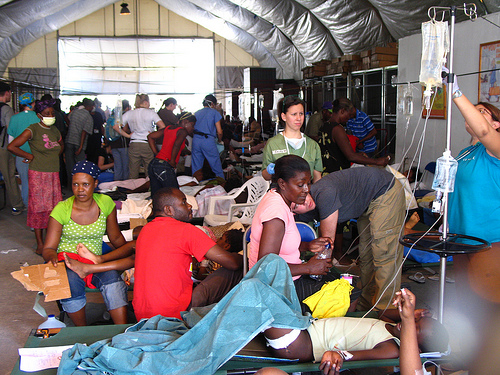
In the days following the devastating earthquake in Haiti in early January 2010, aid workers arrived on the island to offer medical and technical support. With the capital, Port-au-Prince, suffering the brunt of the destruction, transporting supplies and people over destroyed roads proved difficult. Communications technologies, in an immediate post-disaster environment, are critical for aid workers to coordinate relief supplies and to deliver post-disaster care.
Read More
Today is the 40th anniversary of Earth Day, a global celebration that raises awareness about the enivronment. To do our part to celebrate this day, we’ve put together a look at some of the mobile tools and organizations we’ve covered recently that are doing their part to help the Earth. If you have any suggestions about tools or organizations that are doing great environmental work with mobiles, please leave a comment and let us know – and have a good Earth Day!
Water Quality
We recently covered the Water Quality Reporter, a program in South Africa that uses mobiles to test the health of water supplies. The program allows field workers to use mobile forms or SMSs to cheaply and effectively transfer data about water quality to a centralized database, while receiving feedback about how to handle local water problems.
Read More
Finding data on media consumption can be difficult, but the real trouble comes in interpreting it – what does it mean if people in one country get most of their news from radio, while in another from television? How are mobile phones changing the media and communications landscape? How can this data be used to help keep the greatest number of people informed? And why does this information matter?
AudienceScapes, a project of InterMedia, tracks media and ICT consumption in developing countries around the world. Currently the site has detailed information about Ghana, Uganda, Kenya, Sierra Leone, Columbia, Nicaragua, Guatemala and Peru. The site is a useful resource for detailed breakdowns on how different communities are using and consuming media.
Read More
MobileActive hosted the inaugural FAILfaire last night, bringing together mobile technologists and NGOs to talk about failed projects in M4D and ICT4D. Presenters talked about their failed projects, answering the questions: "What was the project? What was the failure? Why did it fail? And what would you do differently next time?”
The event was filled to capacity with more than 70 people. The five presenters made us think (and laugh), and the audience asked some great questions. For those of you who couldn’t be there, here’s a quick look at the failed projects presented at the first (of what we hope will be many) FAILfaire.
Bradford Frost: MobileImpact.org? Not exactly...
Starting off the evening was Bradford Frost, who told the story of his failed non-profit venture, MobileImpact.org. The goal of his project was to bridge the gap between people trying to recycle used phones and developing countries. He felt he had a strong idea and a strong brand with the tagline “One phone. Change the World,” and that there was enough of an untapped phone recycling market (the current cell phone recycling market only captures about 25% of reusable devices) for the project to succeed.
However, the project didn’t work out as Frost had hoped. He used Facebook ads in order to target a younger, social media-savvy audience. He spent 1,000 dollars to launch an ad campaign and $5000 in a partnership with a phone recycling company. In the end, the non-profit gathered 131 phones valued at a sum total of …$252. And many of those phones were donated through word-of-mouth connections (friends and family) rather than people who saw the Facebook ads.
Read More
As we here at MobileActive.org have been covering ICT and mobiles for development now for more than five years, we have seen our fair share of failures. For every great project that changes how a community benefits from technology to improve the lives of its people, there seem to be twice as many projects that fail, and end up wasting time, money, and maybe worst, goodwill.
Too often in our field, we talk up our successes, overhype and overestimate the value of our projects, and sweep the failures under the rug. But, if we don’t talk about what didn’t work (and, perhaps more importantly, why it didn’t work), others will keep repeating the same mistakes.
That is why we invented FailFaire, a gathering that is happening tonight in New York City and that we hope will take place in other cities around the world. FailFaire is a place where it's ok to talk about what didn't work to learn from for the next project using mobiles for social change and development.
Read More
Have an opinion about what you’ve read in the news? Why not text the editor? While many news organizations use SMS to send out news alerts, The Namibian has set up “SMS Pages” in which readers send in text messages to the paper that are then published online and in the physical newspaper.
The Namibian, an independent daily newspaper with news stand sales of 27,000 a day (with an estimated 10-person pass-along rate) and a popular website edition, launched the SMS pages in August 2007.
Read More