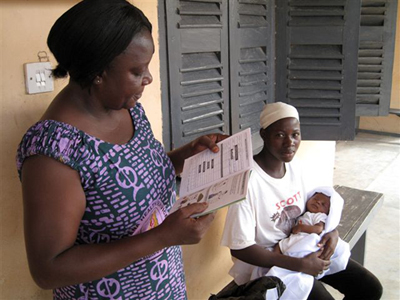
In an effort to bridge the gap between community health workers and patients, the Grameen Foundation is in the midst of a two and a half-year project called Mobile Technology for Community Health (MoTeCH). MoTeCH, a joint initiative between the Grameen Foundation, Columbia University’s Mailman School of Public Health and the Ghana Health Service, is working to determine how best to use mobile phones to increase the quality and quantity of antenatal and neonatal care in rural Ghana.
The project is two-fold. One service targets what Tim Wood, director of the Grameen Foundation’s Mobile Health Innovation and ICT Innovation divisions calls “pregnant parents,” and another targets community health workers.
Read More
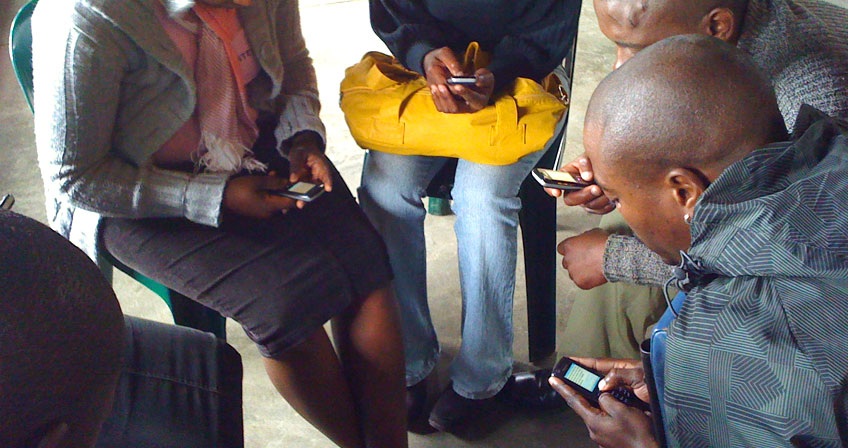
SMS Uprising: Mobile Activism in Africa is a new collection of essays and case studies examining how SMS has been used in Africa for acticism. Essays include Amanda Atwood’s report on Kubatana’s experiences in Zimbabwe setting up mobiles as a means of sharing news outside of government propaganda, to Bukeni Waruzi’s essay on collecting data on children’s rights violations in the Democratic Republic of Congo in 2004. SMS Uprising is published by Fahamu, a British-based organization with a focus on information services for Africa.
SMS Uprising provides the reader with a decent understanding of the state of mobile SMS usage in Africa today. The essays are written by writers, developers, activists, and researchers who are committed to Africa, and cover a multitude of ways SMS can be applied for advocacy work – everything from alerts about political unrest to sharing health information. The book is divided into two parts: context and case studies.
Soukari Ekine, the editor, notes:
SMS Uprising is significant for many reasons not least because it has been edited by an African woman activist. Often initiatives in Africa are studied by people who are quite distant from the continent or are academics who are remote from the grassroots of the subject under discussion. The book is also unique in giving an insight into how activists and social change advocates are addressing Africa’s many challenges from within, and how they are using mobile telephone technology to facilitate these changes...The intention is that the information contained within the book will lead to greater reflection about the real potential and limitations of mobile technology.
Read More
The National Democratic Institute and MobileActive.org are hosting "New Tools for Better Elections", a conference on February 26th on new technologies for fair, representative and equitable elections. In preparation for the event, we sat down with Ian Schuler, Senior Manager of Information and Communications Technology Programs at the National Democratic Institute. Schuler specializes in the application of mobile technology for the advancement of democracy and human rights, He is the author of SMS as a Tool in Election Observation.
In this conversation, Schuler breaks down not only the differences between election observation, citizen reporting, and crowd-sourcing, but also explains why these distinctions matter and how mobile technology is changing the way elections are held. Read on for excerpts from our conversation, or scroll down to watch the interview in its entirety.
Q: You and NDI have done a lot of election monitoring around the world. Explain why election monitoring matters.
A: Elections are the main process by which people participate in their government by selecting their leaders. People expect that it’s going to be a fair process, and that it’s going to be an accurate process. So it’s important for people to have confidence to know that somebody is really systematically watching the entire process to make sure that it is good. Election monitoring prevents fraud by making it harder for the people who want to manipulate elections to do so; it detects fraud when it happens, and it lets people know if the process was good – and if it was not, what were the problems and what might be constructive, non-violent ways of remedying those problems, whether it’s simply improving the process for later or rerunning elections or whatever is warranted in that situation.
Read More
Safe drinking water is a necessity for life. But according to a 2005 report published by the World Health Organization and UNICEF, 1.1 billion people worldwide lack access to quality drinking water.
In South Africa, a current project is monitoring water quality with SMS in a push to bring safer water to the area. Run by the University of Bristol and the University of Cape Town, the four year project is two-fold: 1) develop a new means of testing water quality and 2) develop a new means of reporting the results of these water quality tests.
Aquatest, the water quality testing system, is still under development, but the Water Quality Reporter is up and running – on mobile phones with reporting via SMS. The application allows field workers to cheaply and effectively transfer data about water quality to a centralized database, while receiving feedback about how to handle local water problems.
Says Melissa Loundon, a researcher at the University of Cape Town who worked with the development of the Water Quality Reporter,
“The main part of the project is to develop the water test. But the original project team at the University of Bristol realized that if you’ve got a water test that can be used by people who aren’t in the field, or people who aren’t specialists, it doesn’t really help them if they get a result and see that their water is not safe to drink. They may not have a whole lot of resources to do anything about it. So the point of the cell phone application is that once somebody has a result, they can communicate it to a central database and also to somebody in the area who can provide support.”
Read More
In South Africa, national unemployment stands at 24% – and that number is even higher in many areas outside of major cities. Mobenzi, a new tool created by South African company Clyral, is a project to target unemployed workers to allow them to work over their mobile phones. “Mobenzi agents” use mobile phones to complete tasks that are difficult for computers to process.
Mark Fowles, co-founder of Clyral, said in an interview with MobileActive.org that the pre-pilot run of Mobenzi at the end of 2009 went better than expected. The original plan was to start a formal pilot in April 2010, but the company decided to run a pre-pilot in order to test the feasibility of the program and to iron out any problems before the main run.
Read More
In December 2009, US Congressman Luis Gutierrez (D – Illinois) introduced the Comprehensive Immigration Reform for America’s Security and Prosperity (CIR ASAP) Act of 2009 in the American House of Representatives. The bill is a major step in overhauling the American immigration system, providing greater protection for immigrants while ensuring that employers use fair and legal hiring practices.
As the legislative debate about this hot-button issue heats up, interest groups are increasing their advocacy to protect the rights of both documented and undocumented immigrants. With reform on so many people’s minds, two organizations have been using mobile technology to spread the word.
Read More
The new year is kicking off with an assortment of events on the development and techie sides. Here are some of the events that we found to be noteworthy:
Mobile Tech Salon, 20 January, New York: Hosted by MobileActive.org, it's a regular gathering of people passionate about mobile technology for social change. Motto: We bring the beer (and wine)! Bring your projects, passions, tools, and conversation. This month's theme: Mobile Campaigning and Tools on a Shoestring: What is Possible? Advisable?
International CES 7-10 January, Las Vegas, USA: CES is the world's largest technology trade show, attracting more than 2,500 exhibitors and showcasing over 20,000 new products.
Read More
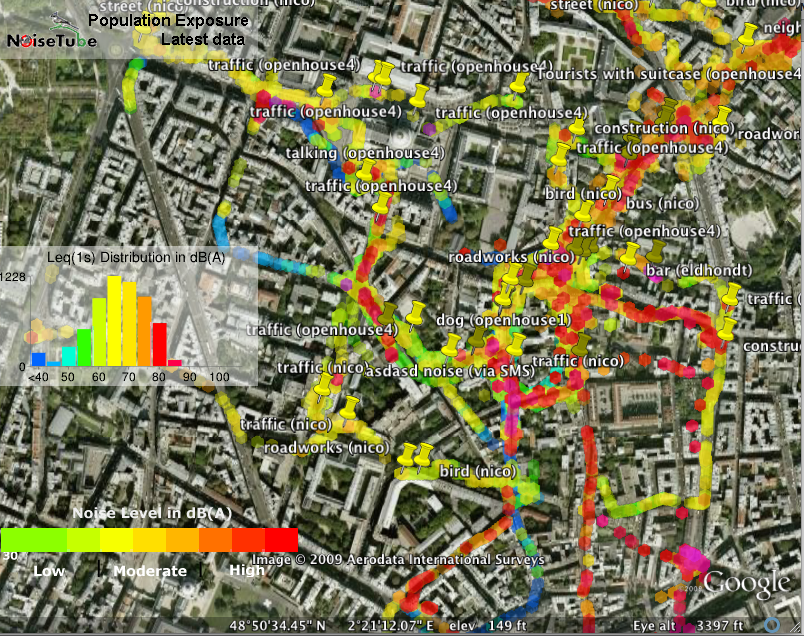
From traffic to construction to everyday chatter, noise pollution is a part of city life. But with the ubiquity of mobiles, documenting noise pollution is getting a little bit easier. NoiseTube and LHR NoiseMap are two projects that use mobile phones to record and map instances of noise pollution.
NoiseTube uses crowd-sourcing to monitor noise pollution. Users with GPS-enabled phones can install a free application that measures the noise level wherever they are. Users tag the recordings with a description of the noise, its source, the time of day, and other criteria, and the data is then mapped onto GoogleEarth; in this way participants can use their phones as noise sensors to automatically share information about their city with other members of the community.
Read More