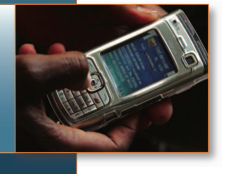
mobile phones

Update on Myanmar/Burma Protests and Mobile Phones

The Myanmar military continued to suppress demonstrations in Burma/Myanmar today with harrowing pictures of tear gas, guns, and beatings directed at the monks and many more civilian protesters, estimated at 70,000 people. We wrote earlier about the use of mobile phones in transmitting information. The BBC today has an update on the use of the Internet in getting information out of Burma, as the country is called by democracy supporters and dissidents. The article notes that mobiles were used to get information out of the country, but also as a tool by the military junta to disseminate rumors and false information.

Read More >>


Do Mobile Phones Answer All our Prayers? Guest Blogger Paul Currion on Mobiles in Food Relief

Reposted from humanitarian.info.

Do mobile phones answer all our prayers? I’ve written about the role that mobile telephony can play in humanitarian assistance quite a few times now, without really talking about it directly. The one line I have consistently taken is that cellphone coverage is not reliable or secure enough to be used as the primary means of communication in an insecure environment.

Putting that to one side for a moment, however, it’s clear that mobile telephony really is the key communications technology for the poor - and that means it should be the key communications technology for the humanitarian community.

Read More >>


Texting It In: Monitoring Elections With Mobile Phones

In Sierra Leone's national election today, 500 election observers at polling stations around the country are reporting on any irregularities via SMS with their mobile phones. Independent monitoring of elections via cell phone is growing aqround the world, spearheaded by a few innovative NGOs.

The story starts in Montenegro, a small country in the former Yugoslavia. On May 21, 2006 the country saw the first instance of volunteer monitors using SMS, also known as text messaging, as their main election reporting tool. A Montenegrin NGO, the Center for Democratic Transition (CDT), with technical assistance from the National Democratic Institute (NDI) in the United States, was the first organization in the world to use text messaging to meet all election day reporting requirements.

Read More >>


Amnesty hits your wallet and Planned Parenthood your ear - What's Next?

Amnesty International announced yesterday that it will accept payments on the UK via mobile phone that will get more money to the charity.  Billed as a "digital wallet", LUUP, the mobile payment vendor that Amnesty uses,  will " make it easier for people to make donations. Says Amnesty: "It will also enable the human rights organisation to receive up to 15 per cent more of the money than via PSMS methods such as regular text."

The UK arm of Amnesty ruled out premium rate text messages for donors as too costly. In Europe and in the US, network operators take a significant percentage of the revenue of premium texting -- up to 50% in some cases, and donations are limited to what are essentially micro contributions.  Using LUUP, however, means that donors can give up to £800 in the UK to Amnesty International, for example.

To encourage donations, LUUP wil add to the money received by donors an additional 20 per cent. Once signed up to a LUUP account, users can also use the service for sending money via SMS to friends via their mobiles and other mobile payment. If the recipient isn't a LUUP member, they'll be sent a text, inviting them to sign up. Users can they keep the money as part of their LUUP account or transfer it to their traditional bank account.

LUUP is currently available only in a few countries in Europe, but mobile payment systems are springing up all over the world, such as India and part of Africa where Safari and other mobile carriers and vendors see huge potential for offering banking services to the currently "unbanked," as the parlance goes.

Meanwhile, In the United States, Planned Parenthood is rolling out a new service with Working Assets, a progressive telecommunications provider.  According to the press release,  Planned Parenthood Wireless will provide 10% of revenues generated directly to PPFA. Planned Parenthood Wireless features competitively priced calling plans, and popular cell phones (I have seen some and they look fine). Working Assets uses the Sprint® network that reaches more than 250 million people in the United States but it limited to this country.

“Planned Parenthood members care passionately about women’s reproductive health and rights,” said Cecile Richards, PPFA president (and the daughter of the late American politician Ann Richards). “Now they have a smart, simple way to support our work and express that passion with every phone call they make, through a wireless service provider that cares.”

Not to be outdone, the other side is already offering similar services.  The Missouri-based Pro Life Communications offers long-distance, local telephone, nationwide cellular, Internet, and soon satellite television services. The company donates about 15% of the monthly bill customers pay to anti-abortion causes.  Another company, Amerivision Communications and it's Affinity 4 brand offers similar services, including pre-paid mobile, credit cards, and DirecTV service.  The company gives 10% of the monthly usage bill back to the pro-life organization of the customer's choice and has contributed more than $75 million to Christian and pro-life groups, according to a recent article.

Charities clearly have discovered telecommunications services as a way to garner financial and political support, and with the mobile market booming it was just a matter of time before our wallets and ears are hit hard.  What will be next?

Read More >>


Mobile Banking in the Global South - Revolutionary Economic Change?

mobile banking phoneMobile banking is taking off, with the potential to change entire economies where the majority of people currently are currently "unbanked," as the term goes. There have been been several very interesting reports and articles recently on the topic.  On the Foreign Policy blog, World bank consultant Christine Bowers writes about the enormous  economic implications that mobile banking has for the world's poorest:
"The World Bank estimates that in many countries, over half the population—"the unbanked"—has never had a bank account. The poor tend to be terrified of banks, since they're often humiliated or ignored when they try to enter them. That means they can't leave their savings anywhere safe, pay a bill without walking the cash to the office, or prove that they're credit-worthy. Meanwhile, mobile phone penetration is through the roof, especially in Africa. In 2000, fewer than 8 million Africans had a mobile phone - now over 100 million do. That's one in nine. Now, anyone with access to a cell phone has a place to keep his or her savings without needing a traditional bank account. We won't see millionaires suddenly emerging from the shantytowns just because they're "banked," but even a small nest egg needs a safe resting place.

Read More >>


Women in South Africa, Domestic Abuse, and Mobile Phones

Following on the heels of the BBC feature on the revolutionary growth and availablity of mobile phones in Kenya, OmyNews features a new project-to-be in South Africa's KwaZulu Natal province.  The UmNyango Project of Fahamu, a MobileActive participant, equips rural women in the Province with free text messaging to report on violence against them and their children, and report other abuses.  The project coordinator, Anil Naidoo, says: ""This is the first time in KwaZulu Natal that we know of, where SMS technology has been used to directly empower women in this way. What makes the project unique is that women will be able to assert their constitutional rights using accessible and sustainable technology." The project will train women how to send and receive messages in their local language.   According to Naidoo, the sms platform "will complement the network of rural legal advice centers that form part of the UmNyango Project. Very importantly though, the SMS platform allows women to anonymously report on gender-based violence without fear of reprisal. We hope that women will be able to assert their constitutional rights through this project."

Read More >>


BBC on mobiles in Kenya: Revolutionizing the economy and local politics

An amazing article yet again on mobiles in Africa by the BBC.  Paul Mason in his two-part series writes about the economic impact of mobile phones, but more importantly, about how mobiles are transforming local politics.

"With one in three adults carrying a cellphone in Kenya, mobile telephony is having an economic and social impact whose is hard to grasp if you are used to living in a country with good roads, democracy and the internet. In five years the number of mobiles in Kenya has grown from one million to 6.5 million - while the number of landlines remains at about 300,000, mostly in government offices. I decided to make a journey through Kenya to gauge the impact on the ground: the plan was to go from Mombasa via Nairobi to Lake Victoria following the mobile network map - contrasting life on the network to life off it."

Read More >>


Ringing in the Vote: Mobile Phones in the 2009 Indian Elections

The world's largest democracy, India, is holding its general election this year. The month-long elections to the 15th Lok Sabha, the Indian Parliament, will be held in five phases between April 16th and May 16th when the final results will be announced. 

As India's 714 million voters prepare to elect their 543 representatives, they are witnessing a range of digital initiatives from political parties, civil society organizations, media houses and even corporations.  In fact, some observers are calling this India's first digital elections.

Leading the packed ballot is 82-year-old Lal Krishna Advani, the prime ministerial candidate of the Hindu nationalist Bharatiya Janata Party, who has embarked on an Obama-style new media campaign. Part of the campaign are a blog, a blogger outreach program, one of the most aggressive online ad campaigns ever seen in India, and an ambitious SMS campaign that will reach 250 million of India's 400 million mobile subscribers.

Read More >>


Mobile Activism In African Elections: A Paper and a Missed Opportunity

I have been meaning for a while to respond to a paper Rebekah Heacock, a graduate student at Columbia, wrote last year. Hancock describes in Mobile Activism in African Elections (PDF) three recent elections in Kenya, Nigeria, and Sierra Leone, and how mobile technology was used for both crowd-sourced and systematic election monitoring.

She poses that: 

The proliferation of mobile phones in Africa is transforming the political and social landscape of the developing world, empowering people to source and share their own information and to have a greater say in what comes to international attention. This paper compares the use and impact of mobile technology in three recent African elections: Nigeria, Sierra Leone and Kenya.

Read More >>


International Women's Day: Women in Mobile and Mobile for Women

Today is International Women's Day and we are celebrating by featuring innovative women in the MobileActive.org community who are making a difference by using mobiles for social impact. Many of these social innovators are indeed focusing their work on improving the lives of women - their health, incomes, and social and political well-being.  We salute you all! 

Melissa Loudon is a research officer at the Centre for Spatial Data Management at the University of Capetown in South Africa. She is also a talented mobile developer who used to work at Cell-Life, and she has written extensively for us, testing applications. Her most recent review of mobile tools for social development focused on data collection using a mobile phones.

Read More >>


Fundraising with a Mobile

Mobile fundraising is taking off -- or so at least hope nonprofits hard hit by the economic downturn. Organizations are looking for a new channel for people to give on the spot, wherever they are, with their phones and a quick text message.

Mobile giving via SMS in the United States and many other parts of the world, has been out of reach because of high carrier charges - up to 50% of a donation would go to the telcom -- unacceptable to most charities.

But this has changed in the last two years.  Mobile donation campaigns in the United States that go through the Mobile Giving Foundation are not subject to the high carrier fees.  The Mobile Giving Foundation charges a smaller percentage fee -- currently 10%.  As a result, in 2008 the field of mobile giving in the U.S. attracted the attention by organizations large and small, including by such brands as UNICEF, the Salvation Army, and the American Society for the Prevention of Cruelty to Animals.

Read More >>


Jeffrey Sachs on the Mobile Revolution: Deregulate and The Closing of the Digital Divide

Jeffrey Sachs, the noted and at times controversial development advocate, spoke to All Africa about the significance of mobile phones in Africa.  Sachs is also the director of the Earth Institute at Columbia University in New York which runs the Millennium Villages in 12 locations across Sub-Saharan Africa.  Sachs' assertion  that has often been repeated is that "the cell phone is the single most transformative technology for development."  Asked by All Africa about this claim, he noted that rural poverty especially has been characterized by isolation. Mobile phones have 'broken that isolation', as Sachs notes. 

Read More >>


World Aids Day and the Role of Mobile Phones in Combatting HIV/AIDS: Project M

Today is World Aids Day, a day where individuals and organisations from around the world come together to bring attention to the global AIDS epidemic.

Mobile phones are increasinly playing a key role in combatting HIV/AIDS, providing public education and information services, patient monitoring and support, data collection, emergency medical services, and even educational games. 

We have written much on this topic, of immense importance to the world where there are now more than 33 million people living with the disease, making it one of the most destructive epidemics in recorded history.  Throughout the day, we'll feature a few projects that use or have used mobile technology in HIV/AIDS prevention and treatment that stand out.

Read More >>


A Mobile Voice: The Use of Mobile Phones in Citizen Media
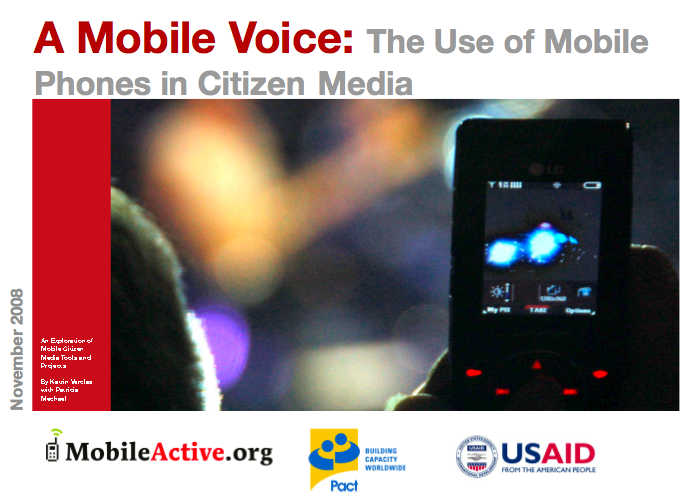
We are pleased to release the newest MobileActive.org resource, A Mobile Voice: The Use of Mobile Phones in Citizen Media.

In this report we explore the dynamics of the role of mobile phones in enhancing access to and creating information and citizen-produced media.  We explore trends in the use of mobile telephony with a focus on software and platforms that make content creation and broadcasting easier.  We also present an inventory of current and potential uses of
mobile phones to promote citizen media and freedom of information, and present short case studies of examples--all from the MobileActive.org community.

Read More >>


Does Mobile Tech Help Women?

Kutoma Wakunumadid a great presentation at MobileActive08 on her research that investigates whether women are benefitting from mobile technology. In this interview, shot by ICT4D.at at MobileActive08 in Johannesburg this year, she discusses how women are using mobile tech, what some of the barriers are, and social implications of mobile communications for women. A blog post about the discussion we had at MobileActive08 about women and mobile phones is here.

Take a look also at the notes from a session on participatory design for mobile tech with and for women here and an earlier article we wrote about women and mobile technology -- Who Will Join This Standing Up.


Millennium Village Project mHealth Program

operates in:
Ethiopia, Ghana, Kenya, Malawi, Mali, Nigeria, Rwanda, Senegal, Tanzania, Uganda

contact:

Patricia Mechael, PhD MHS


mHealth and Telemedicine Advisor

Millennium Villages Project

Earth Institute at Columbia University

Tel: +1 (973) 222-8252

E-mail: pmechael@gmail.com

Web:  http://www.millenniumvillages.org/

Increased mobile network connectivity provides a wide range of benefits for people living in developing countries.  Handsets and service subscriptions have been prioritized for their ability to provide time and costs savings in business and social engagement. In recent years, the benefits of mobile phones in the health sector have also become apparent as an extension and/or replacement for existing telemedicine and data collection systems.  In this context, the field of mobile health, or mHealth, has arisen aiming to explore the utilization of mobile phones and other mobile technologies to strengthen health systems.
 

Read More >>

References / Past Projects

The Millennium Villages project is led and executed by the communities on the ground in Africa. Throughout the continent, more than 400,000 people are leading this bold initiative, giving their time, skills, and resources to make the project a success and one that is relevant to local conditions. Because Millennium Villages are an investment toward a sustainable end to extreme poverty, Millennium Village communities strengthen their local governments and institutions and certify the preparation and implementation of the interventions in their community. This is necessary to ensure that their development will become sustainable and self-sufficient.

The Millennium Village project is based on the findings of the UN Millennium Project and is led by the science, policy and planning teams at The Earth Institute, Millennium Promise and the United Nations Development Programme.


First Impressions from MobileActive08

Greenpeace Argentina, Al Jazeera, Unicef, Burmese monks, healthcare workers in ten African countries, geeks and IT entrepreneurs, 380 people from 45 countries: what's the common link?  Mobile technology with a social mission.  Whether it's sharing medical information in rural Mozambique, or helping getting the word out about post-election violence in Kenya or getting accurate demographic data in regions with no IT structure, or using phone minutes for micro-banking or social marketing, someone here (and there are close 400 participants)  is talking about it, and others are sharing their experiences, with each other of course, and with any social network you've heard of from Twitter to Flickr to Youtube to Facebook.  

In general the flash of the IT world is mixed with a fair amount of humility; most people are here as much to listen, and get the lay of the land as they are to present the killer app or networking tool.

For me, coming from New York, the notion that Katrin Verclas suggested, that the event is packed with people and information precisely because it's in Africa, rings true.

Read More >>


Development 2.0 - Another Mobile Application Competition

There is yet another competition focused on mobile app development, this time sponsored by USAID and Netsquared. Starting on October 13, Development 2.0 will reward the innovative uses of mobile technologies for international development withup to $10,000 for the winner. While this is less than some of the other recent competitions, applicants can get advice and improve their ideas and clarify their project submissions during the entire application process on a project gallery.

A open voting process will determine the best projects, and then a jury of USAID senior staff will select the final winners. More info is here.

Other compeitions open right now:

Knight News Challenge -- $5 million awarded to digital media projects, including mobile citizen media projects;

Read More >>


Mobile Warriors: Costa Rican Youth, Mobile Phones and Social Change

This article was written by Lisa Campbell of the Youth Action Network and is reprinted here with permission.  Lisa's research and articles are on her blog Mobile Revolutions.

Globally 1.5 billion people have access to televisions, and 1 billion to the Internet; yet overall the most actively used electronic gadget is the mobile phone, with over 3 billion users worldwide. Reaching the 4 billion mark before the end of 2008, that equals to approximately one cell phone for every two human beings. Under 30-years in existence, cell phones are one of the most rapid developing technology the world has ever known. According to Touré, Secretary General of the ITU, “The fact that 4 billion subscribers have been registered worldwide indicates that it is technically feasible to connect the world to the benefits of ICT and that it is a viable business opportunity.”  According to Touré, “Clearly, ICTs have the potential to act as catalysts to achieve the 2015 targets of the MDGs.”

Mobile phones are the first telecommunications technology to be more popular in developing nations, than their developed counterparts, far outnumbering internet coverage (Zuckerman 2007). More and more people are using their phones to access the internet instead of computers.  Soon there will be more cell phone users than literate people on the planet. This signifies a shift into a new age of digital literacy, where avatars, emoticons, pictures, sounds and videos often hold more power than names and numbers.

Economists around the world are hailing cell phones as the solution for ICT development and a ray of hope in bridging the digital divide.

Read More >>


Mobile Phones and the Flood in Bihar, India

One India reports on how mobile phones are used after the devastating floods in Bihar, India. While relief and aid have been very slow to get to Bihar, mobiles are proving to be a life saver.  According to One India,

Read More >>


Mobile Telephony Makes a Difference in Livelihoods

Agriculture is what keeps economies in most developing countries alive. However, farmers in many countries face major challenges. In an age of global markets, they are forced to enhance production, improve the quality of their yield, and access markets within short timeframes.  Small-scale farmers especially have traditionally been deprived of weather and crop information, have been at the mercy of middlemen, and have lacked timely market price information to negotiate the best deal. This has chancged with the a connect people advent of widespread telephony that connects farmers wiith markets, weather, and other data. 

Read More >>


Register Now for MobileActive08!

SANGONeT and MobileActive.org invite you to register now for MobileActive08.  MobileActive08 is the only global gathering that is connecting leaders who are working at the convergence of civil society, mobile technology and social change.  If you:

  • have expertise in the field of mobile technology for social development,
  • are a researcher working on mobile technology for social impact, or
  • are a mobile service provider with interest in the social market,

MobileActive08 is for you.  Register now!

MobileActive08 is the largest event to date focused on mobile technology for social development. This global gathering brings together people like you - practitioners, researchers, technologists and donors experienced and interested in the use and application of mobile technology for social impact.  Register now!

At MobileActive08 you will explore how mobile phones are effectively used to advance civil society work, assess the current state of knowledge in the use of mobile technology to advance social development, and investigate trends, needs and investment opportunities.

We will cap attendance at 350 people and we expect to fill up quickly, so please register now to ensure your participation. Our partners at SANGONet and we at MobileActive.og look forward to welcoming you to South Africa!


The DOs and DON’Ts of Mobile Advocacy

Mobile social marketing works in increasing awareness and moving people to actions. It is also becoming an effective way to engage users and constituents. Throughout our experience with mobile campaigns, we've run into the some great campaigns and some failures as well.

Read More >>


What can you do with a mobile? Case studies from Advocacy, Service Delivery, and Fundraising

Note: This primer was written for the NTEN newsletter, targeted at a US audience and thus focuses on America. For more on mobile advocacy in many other parts of the world, see here.

Read More >>


New Report Looks at Economic Benefits of Mobile Phones

A new report, Perceived economic benefits of telecom access at the Bottom of the Pyramid in emerging Asia, takes a new look at the effect of mobile phones on the lives of people at the so-called 'bottom of the pyramid.' The report, published by LIRNEasia, states that although anecdotal evidence shows that mobile phones are economically beneficial to base-of-the-pyramid users, there is little empirical evidence to reinforce this claim.

Read More >>


Find a mobile project.
Find a tool or vendor.
Add your mobile tool, project, or company.
 
 
The Tool in Your Hand: The Mobile Revolution

 
 
Google Groups

Subscribe to MobileActive's Discussion Group

Email:
Visit this group
 
 
Twitter Updates

Twitter Updates

    Follow us on Twitter