The Use of Mobile Phones
in Citizen Media
Supported by USAID and
written by
Katrin Verclas and Patricia Mechael.
The Mobile Marketing Association (MMA) has released the latest version of its ‘U.S. Consumer Best Practices (CBP) Guidelines for Cross-Carrier Mobile Content Services’. Updated regularly, the guidelines are the industry standard for cross-carrier mobile content services such as text messaging (SMS), multimedia messaging (MMS), shortcode programs, Interactive Voice Response (IVR) and mobile web.
The new, version 4.0 guidelines are the first to consolidate the individual mobile marketing guidelines and codes of conduct – known as ‘carrier playbooks’ – of the four largest US wireless service providers: Verizon Wireless, AT&T, Sprint and T-Mobile USA. Announced in March 2009, the MMA says this agreement is a milestone toward the continued growth of mobile marketing and will achieve operational efficiencies for the industry upwards of $200 million (£121 million) annually.
Produced by the MMA’s CBP Committee, the guidelines provide measures of acceptable and unacceptable practices for all players in the US ecosystem. At 100 pages, the new CBP document is significantly more comprehensive than the previous edition, but the MMA says it provides the industry with the first concise, inclusive set of guidelines, by eliminating the need to refer to four separate carrier playbooks.
In addition to incorporating carrier standards, the new guidelines include revisions and additions to key areas such as standardizing the language; allowing for more flexibility with PIN location in message-terminated (MT) messages; and modifying the STOP requirement in Opt-in MT messages.
The guidelines also feature a new reference ID system designed to make it quick and easy to navigate the document and find information. The guidelines help standardize practices across the industry which provides a better experience for customers by ensuring the consistency of mobile marketing campaigns across the four major US carriers.
“The latest MMA Consumer Best Practices Guidelines are an industry milestone toward meeting the ecosystem’s need for a concise yet comprehensive set of rules at a time when rapid growth increases the challenge of following multiple playbooks,” says MMA CEO and President, Mike Wehrs. “By providing a single, industry-standard reference, the new guidelines free carriers, technology companies, brands, media companies and consumer advocates to focus on protecting consumers, providing the optimal user experience and continuing the mobile channel’s growth.”
The guidelines are available for download here.
[via The New York Times]


Got five minutes? Rather than check on your car insurance, you can engage in all sorts of do-good efforts these days thanks to a slew of Web sites, including The Extraordinaries, a microvolunteering service. But the idea has plenty of potential pitfalls — and could end up just a flashmob in the pan.
» E-Mail This » Add to Del.icio.us
 A recent report on ABC news highlighted how students in rural areas of India were using their cell phones to learn languages. One of the benefits of using student cell phones for learning in India is that they can learn away from school (since many are forced to skip school so they can work).
This third “What Google Should Do In Africa” post could be subtitled “Grow some balls”. Why, oh why, is it that Google, so unafraid to tackle telco and broadcast market behemoths in the United States, behaves like a timid NGO in Africa?
Although this post has been in the queue for a while, the timing now could not be better as two days ago Google launched innovative new SMS-based services in Uganda in partnership with the Grameen Foundation and MTN. This provoked a response from Katrin Verclas (@mobileactive) in which she queried the apparently high costs of the premium SMS charges being levied. This was riposted by Erik Hersman (@whiteafrican) who rephrased Katrin’s post as the question “If you provide services to the poor, should you make a profit?”.
For me the problem is not whether the poor should pay for services. I don’t think anyone engaged in this discussion believe the poor shouldn’t pay for services that are of value to them. It is not even whether they should pay a premium rate for services. The problem for me is the base rate itself of SMS charges. Google and Grameen have correctly identified the tremendous potential power of SMS as a technology that can effectively provide data services to the poor. However, this transformative technology, whose marginal cost of deployment is effectively zero, is being throttled by mobile operators charging a disproportionately high price for the service. Mobile operators in Africa still embrace the economics of scarcity.
In his post, Erik makes a provocative statement. He says,
If there’s a problem with collusion and price fixing in an industry (like there sometimes seems to be with SMS services in a country), that’s something beyond the scope of individuals and needs to be tackled separately by regulation.
If only it were that simple. Telecoms regulation in Africa is in a parlous state. With few exceptions (Nigeria being a notable one) communications regulators in Africa are under-resourced and often insufficiently independent from governments who maintain a substantial investment stake in the incumbent fixed-line and mobile operators.
So what happens in practice? Regulators often start out well. They issue a call for public input on issue X, be it interconnection, local-loop unbundling, carrier pre-select, spectrum licensing or what have you. Who responds to these calls for input? Right now in most African countries the only organisations effectively lobbying the regulator are fixed-line incumbents and mobile operators…. with PREDICTABLE RESULTS. The old joke about a telecom company being a law firm with an antenna stuck on top is actually not that funny in Africa. Incumbent operators are experts at both influencing policy and regulation development and at stalling any efforts to reform unfair practices.
For the rest of us, lawyers are notoriously expensive and there are few civil society organisations with the resources to actually draft the kind of input that regulators need in order for there to be a balanced debate. There is a desperate need for organisations like Google who have a vested interest in seeing more data traffic to help lobby for more competition, for lower barriers to entrepreneurship in the telecom sector, and for cheaper access for all.
So when I see the company that wagered billions in the 700MHz spectrum auction in the U.S. to effectively arm-wrestle Verizon into OpenAccess conditions, the company that has made countless submissions to the FCC to lobby for unlicensed access to television white spaces spectrum, announce that they have “partnered” with a single mobile operator in Uganda to deliver SMS services, you will understand me if I seem a little let down. The new SMS services for Uganda ARE innovative and I believe they have been well-conceived. Kudos to the Grameen Foundation for developing them and to Google for supporting them. Am I wrong to want more from one of the most innovative companies in the world?
Imagine the innovation in services that might be unleashed if SMSes were priced so that Africans didn’t have to think twice about sending them. Imagine the economics of abundance being applied to the telecoms sector in Africa. Sadly, voices calling for this on the continent are not nearly loud enough. Google, which represents that principle so well, disappoints by failing to stand up for it.
It’s not sexy, it’s not whizz-bang, but it is true that Google could have a more profound effect in Africa by hiring a few lawyers, lobbyists, etc who can help level the playing field for the regulators on the continent than a dozen SMS services.
Ironically, Chris Anderson’s new book that explores the economics of abundance quotes Google CEO Eric Schmidt on the cover. Schmidt says:
“With the cost of distribution relentlessly driving towards zero, Chris Anderson, has once again identified the next big thing”
If he really believes that, why not Africa too?
If you provide services to poor people, should you make a profit?Post from: Many Possibilities
Entries in this series:Related posts:

 Just over a year ago in Cairo, we convened the first Mobile Money Summit with our friends at the GSMA, DFID and IFC. The diversity of the crowd was fantastic - people from all over the world and all sorts of business - from mobile network operators to vendors to financial institutions. It might sound corny, but Hannes Van Rensburg captured the mood quite well: “A general spirit of: ‘Let’s build the industry’ rather than criticise each other prevailed.” (Mobile Payments have arrived)
Today’s the second and final day of this year’s Mobile Money Summit, and the key words here are data and partnerships:
Data - around the market opportunity for mobile money - by the year 2012 CGAP and GSMA estimate there will be 1.7 billion people with a mobile phone but not a bank account and as many as 364 million unbanked people could be reached by agent-networked banking through mobile phones;
Partnerships - a slew of deals announced yesterday illustrate the momentum around mobile banking services, notably: Visa Launches First Commercial Mobile Payment Service in Latin America.
Does this mean momentum around mobile banking for the unbanked has reached a no-turning-back stage? Not quite. As CGAP’s Technology Program Manager Steve Rasmussen noted in his presentation titled “The Hype Cycle and Mobile Banking:”
Finally, some snapshots from the podium:
What’s the verdict for this year’s event? And where are we on that hype cycle? Reuters has weighed in already: Mobile money seen as chance for world’s poorest.

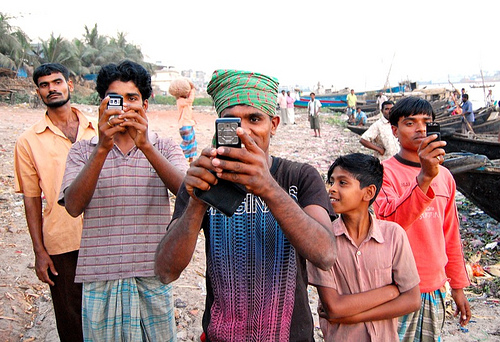 Tens of thousands of mobile users in Bangladesh's flood and cyclone-prone areas will now receive advance warning of an impending natural disaster through an alert on their cell phones, reports Reuters.
 ... Bangladesh, with a population of around 162 million, has more than 46 million mobile phone subscribers.
Syed Ashraf, communications specialist for the country's Disaster Management Bureau, told Reuters by telephone that the messages would not be the usual SMS format, but would flash automatically on the screen of mobile phone sets, instead of going to message boxes.
This way, people would not have to even push a button on their handsets, making it very user-friendly, he said.
Image from newleypurnell's photostream on flickr.
 Last week I quoted from Robert Fabricant’s contribution to a Fast Company discussion roundtable on the impact of the mobile phone.
Robert has meanwhile posted the full text of his response to the questions. Here another quote:
“Density and connectivity are the keys drivers of social transformation and mobile technologies are the medium. There may be a scarcity of financial resources in the the developing world but their is an abundance of social resources. This is no longer about leapfrogging the wired telecommunications infrastructure. The effects are far more profound in terms of economic development and social transformation.
I spend a great deal of time working with social impact initiatives in health, agriculture and conservation and in almost every case the key point of leverage is mobile technologies. And what most designers don’t realize or want to realize is the degree to which the most basic platforms like SMS, USSD and Voicemail can support rich services that create social value way beyond what we experience in the US market. Services that are far more profound than Urban Spoon. We are blinded by the iPhone and the Blackberry into thinking that these sophisticated gadgets are necessary to build rich applications. Just look at what Unicef is doing with rapidSMS and rapidAndroid to transform healthcare delivery and respond to global emergencies like famine, disease and warfare.”
The digital activism and resistance witnessed in Iran go to the heart of my dissertation research, which asks whether the information revolution empowers coercive regimes at the expense of resistance movements or vice versa? Iran is one of my case studies for my upcoming field research in addition to Burma, Tunisia and Ukraine.
IntroductionThere have been a number of excellent blog posts on the intersection between technology and resistance in Iran, and especially on the use of Twitter. The mainstream press is also awash with references to Twitter’s role. For example, Agence France Presse (AFP) recently cited my research in this piece entitled “Twitter Streams Break Iran News Dam.”
However, what I haven’t seen in the blogosphere and mainstream press is the application of an analytical and theoretical framework to place Twitter’s use in Iran into context.
For example, just how important is/was Twitter’s role vis-a-vis the mobilization and organization of anti-government protests in Iran? We can draw on anecdotes here and there but this process is devoid of any applied social science methodology.
This post seeks to shed light on how, when and why information and communication technologies (ICTs) are used by resistance movements in repressive environments. The framework I draw on (summarized below) is informed by Kelly Garrett’s excellent publication on “Protest in an Information Society: A Review of the Literature on Social Movements and New ICTs” (2006).
FrameworkThe framework seeks to “explain the emergence, development and outcomes of social movements by addressing three interrelated factors: mobilizing structures, opportunity structures and framing processes” within the context of ICTs. (The figure below is excerpted from my dissertation, hence the figure 4 reference).
These three factors should be further disaggregated to facilitate analysis. For example, mobilizing structures can be divided into categories susceptible to the impact of ICTs:
These sub-indicators are still to broad, however. Take, for example, participation levels; what is participation a function of? What underlying mechanisms are facilitated or constrained by the wider availability and use of ICTs? Participation levels may change as a function of three factors:
These activities are of course not mutually exclusive but often interdependent. In any case, taking the analysis of ICTs in repressive environments to the tactical level facilitates the social science methodology of process tracing.
ApplicationWe can apply the above framework to test a number of hypotheses regarding Twitter’s use in Iran. Take Mobilizing Structures, for example. The following hypothesis could be formulated.
Using process tracing and the above framework, one could test hypothesis 1 as follows:
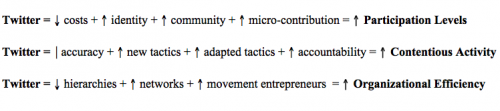
These causal chains, or “micro theories,” are posited with the “⎥” marker to signify that the causal relationship is contended. The direction of the arrows above reflects the theoretical narratives extracted from the theoretical framework presented above. Note that the above “micro” theories are general and not necessarily reflective of Twitter’s use in Iran.
Iran Case StudyWhen the arrows are tallied, the results suggest the following general theory: there is a direct and positive relationship between the impact of Twitter and the incidents of protests and riots. The next step is to test these “micro theories” in the context of Iran by actually “weighting” the arrows. And of course, to do so comparatively by testing the use of Twitter relative to the use of mobile phones and the Internet. Furthermore, the results of this hypothesis testing should be compared to those for Opportunity Structures and Framing Processes.
I plan to carry out field research to qualitatively test these hypotheses once the first phase of my dissertation is completed. The first phase is a large-N quantitative study to determine whether increasing access to ICTs in repressive regimes is a statistically significant predictor of anti-government protests.
From Fierce Wireless:
Executives from the nation’s two largest carriers defended their respective text messaging rates at a Senate hearing yesterday, denying allegations of collusion among Tier 1 carriers to raise text messaging prices.
Randal Milch, Verizon’s executive vice president and general counsel, said in testimony before the Senate Judiciary Committee’s subcommittee on antitrust, competition policy and consumer rights that it was "absolutely false" that carriers conspired to raise rates on certain types of text messages.
Milch said that most Verizon customers buy their text messaging plans in buckets, instead of "by-the-drink" text messages, meaning text messages purchased outside of bundled plans. Customers pay a fee per text message in those cases. He also said that individual text messages not purchased through post-paid plans represent less than 1 percent of the text messages Verizon provides.
An AT&T representative made similar pronouncements. "The faulty notion that prices for text messaging have risen derives from an unduly narrow interest in the trend of a single pricing option for text messaging services, the pay-per-use option, when the vast majority of AT&T’s customers do not choose that option," said Wayne Watts, general counsel of AT&T, according to Reuters.
Not surprisingly, industry association CTIA echoed the sentiments. "The U.S. wireless industry is the most competitive and innovative in the world. Third party organizations and influentials-from Consumer Reports Magazine to Former Vice President Al Gore-have echoed this statement," CTIA chief Steve Largent said in a release, which cited association figures showing 270.3 million U.S. wireless subscribers sent more than 1 trillion text messages in 2008, up from 2007 when 255.4 million subscribers sent 363 billion text messages.
Last fall, shortly after Sen. Herb Kohl (D-Wisc.), the subcommittee chairman, sent letters to AT&T, Sprint Nextel, T-Mobile USA and Verizon asking them to justify raising rates on "by-the-drink" text messages, the carriers were hit with lawsuits claiming the carriers conspired on test-messaging pricing. Verizon’s Milch, in his testimony, said there was a great variation in the four carriers’ prices for these messages for prepaid customers:
These variations, as well as variations in how the carriers price bundled messages, show that there are more differences than similarities in how the carriers price text messages, according to Milch. "Nor is there any coincidence in the timing of price changes for the narrow category of post-paid ‘by-the-drink’ text messaging," Milch said in his testimony. "Different carriers changed prices for this product over a period of almost two years. There was no collusion or price-fixing."
We at Mobivity are not so sure the carriers are colluding but we are pretty sure they are getting greedy. The cost of a text message is next to nothing and the margins on them are insane. Carriers best make note of the old adage "pigs get fat and hogs get slaughtered" Oink Oink.
Technorati Tags: sms,text message,Mobivity,CTIA
del.icio.us Tags: sms,text message,Mobivity,CTIAGDC congratulates Development 2.0 Challenge winner RapidSMS for having successfully completed its pilot study in Malawi. The results are now available on their website.
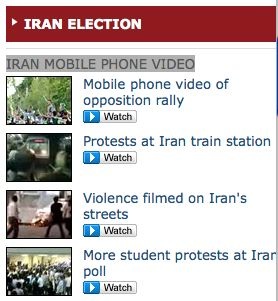 With traditional forms of communication blocked, Iranians are using technology to keep the world informed about events. The BBC reports.
Middle East political and security analyst James Spencer told the BBC: "As foreign correspondents find their work restricted and their visas curtailed, the ubiquity of the mobile phone... is coming to the fore.
The ability to send graphic, near live-time footage, often then uploaded to YouTube elsewhere, is an incredibly powerful tool.
"This raw imagery has little need for translation or editing, and often under-cuts the State's message, both in content, and by pre-emption."
He added that tags like "IranElection" on the social networking site Twitter have attracted huge numbers of "followers".
These tweets often reference a YouTube clip or a URL, thus further increasing the audience, he said.
A YouTube spokesperson said there had been an increase in activity for all types of videos related to the Iranian election.
 Talking about Zain seems to be the flavour of the month here at DTW. Following yesterday's piece about the future of the group's African assets, today I'd like to zero in on one of the these, the company's MNO in Malawi, which, according to a recent Cellular News story has clashed with the country's telecoms regulator over plans to lower tariffs.