"Innovations in Mobile Data Collection for Social Action," a workshop co-hosted by MobileActive.org and UNICEF in Amman, Jordan, featured Ignite Talks -- five minute presentations by inspiring people who are using mobiles for social action in the Middle East -- and interviews with key participants. Jacob Korenblum describes the work of Souktel in Palestine, and Erica Kochi from UNICEF Innovation, the co-host of the event, illustrates why data collected by mobiles is so important for their work in Iraq.
We will be blogging and twittering this week from a workshop we are co-hosting on Innovations in Mobile Data Collection for Social Action in Amman, Jordan.
Co-hosted by UNICEF’s country office in Iraq, UNICEF Innovation, and MobileActive.org, this three-day gathering is bringing invited experts from around the world together to explore some of the key issues related to using mobiles for data collection and analysis of some of the toughest social issues.
Why are we hosting this event?
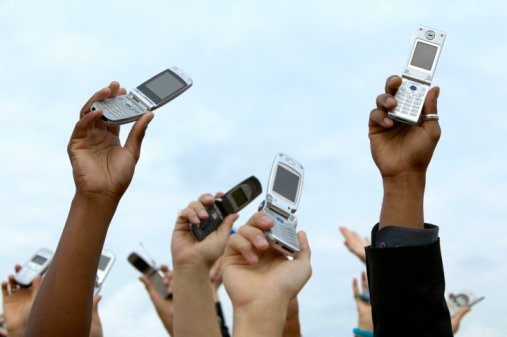
With the ubiquity of mobile technology, data collection and monitoring of key indicators from the ground up by affected populations is now possible. Mobile technology in the hands of people can now be more than a person-to-person communication medium but can be used for capturing, classifying and transmitting image, audio, location and other data, interactively or autonomously.
Two of the fastest-growing and popular mobile data collection tools have recently seen some exciting upgrades in newly released versions.
Open Data Kit recently released v1.1 of ODK Collect. Open Data Kit (ODK) is a suite of tools to help organizations collect, aggregate and visualize their data. ODK Collect is powerful phone-based replacement for paper forms. Collect is built on the Android platform and can collect a variety of form data types: text, location, photos, video, audio, and barcodes. ODK Collect can be downloaded in the Android marketplace or here. The developers also have a demo video that describes the new features of the release. Open Data Kit is a member of the Open Mobile Consortium of which MobileAtive.org is a founding member.
Some of the new features of ODK Collect include barcode scanning, image/audio/video capture and playback, editing of saved forms, and device metadata (phone number, IMEI, IMSI) support. GPS acquisition and form processing is a faster, and the developers added review data entry. The user interface has been field tested and reworked to make training and use much easier. ODK Collect also supports question grouping, repeats, constraints, complex logic, and multiple languages.
ODK is currently deployed for HIV counseling with AMPATH in Kenya, user feedback gathering for Grameen's AppLab in Uganda, war crime documentation with the Berkeley Human Rights Center in the Central African Republic, and forest monitoring with the Brazilian Forest Service.
Meanwhile, our friends over at Datadyne have released version 2.0 of their popular mobile data collection platform EpiSurveyor. For some of the very cool GPS features of that, see the video below. EpiSurveyor is a free, user-friendly mobile-phone-and-web-based data collection system. Version 2.0 has many new features such as GPS (users with GPS-enabled phones (like the Nokia E71) can automatically create a "GPS stamp" for every record collected AND automatically see the results on a Google map, all within EpiSurveyor.org), advanced logic, including skip logic; numeric range limits for data entry; and a much better user interface for the web-backend.
EpiSurveyor is used by organizations around the world. One organization, TulaSalud in Guatemala, uses EpiSurveyor for maternal health. The video below (en Espanol) explains how the organization is using the tool.
Video informativo de TulaSalud, sobre la aplicación del sistema de monitoreo epidemiológico aplicado con la tecnología de EpiSurveyor, el cual pretende tener a tiempo real el reporte epidemiológico de las comlunidades.
Would you give 15 minutes of your time for a really good cause (and a chance to win a prize)?
Vodafone has recently launched a new version of Betavine, the open mobile application community. This new version encompasses a pilot project called "Social Exchange", which aims to foster the creation of mobile solutions for problems in the developing world.
The project’s aim is to create a website that brings developers, NGOs and community organisations together in order to develop mobile solutions to some of the difficulties faced by people in the developing world. Your input will help Vodafone to make this worthwhile project into a real success.
By participating in a quick and easy online process, you'll also have the chance to enter a prize draw to win a £50 Amazon voucher or one of two £25 ones. If you are willing to help, please go to the following webpage, which will explain everything you need to know: http://www.webnographer.com/do/betavine/socialexchange
After the hectic month of October where there were way too many events focused on mobiles for social impact, November is a bit more technically focused. To help you find your way in this fast-moving world, we’ve compiled a round-up of some key events that are taking place throughout the month of November.
DroidCon Nov. 2-4 (Berlin, Germany) DroidCon is the first Android business and developer conference in Germany. It covers everyting you want to know about the Open Handset Alliance mobile platform. Not focused on mobiles in social impact, but an indication that Android is starting to hop.
iPhone Developer Summit Nov. 2-4 (Santa Clara, CA, USA) Technical sessions explore web development opportunities on the iPhone, including building social applications and developing high-quality, iPhone-style web-based GUIs for applications.
People in the developed world consider the phone a very personal object, something that is always on and always with us. In many developing countries, that's not always the case. People share phones, and many don't own handsets because they are too expensive.
A new company, Movirtu (with a catchy tag line: "Mobile for the next Billion"), wants to extend coverage to so-called bottom-of-the-pyramid customers by using a handset-independent way to connect to the mobile network. The company's goal is to "expand the use of mobile communication by the rural poor communities in Sub-Sahara Africa and South Asia living on less than $2 a day" - in order to improve their livelihoods. The method for doing this is to detach owning a phone number from owning a handset--and to allow users to own numbers without owning handsets. And its gaining attention: CEO Nigel Waller was awarded a PopTech Social Innovation fellowship this year, and Movirtu has been shortlisted for Africom's Changing Lives Award.
This post is reposted from the Open Mobile Consortium, a community of mobile technologists and practitioners working to drive open source mobile solutions for more effective and efficient humanitarian relief and global social development. It is written by Neal Lesh.
One of the Open Mobile Consortium's (OMC) primary goals is to maximize interoperability and data-sharing capabilities among the open-source mobiles technologies so that the whole of our collective effort is greater than the sum of the individual parts.
The Mobile Citizen Project, which aims to fund and support mobile initiatives for social change in Latin America, launches today. The program is a project of the Science and Technology Division of the Inter-American Development Bank, with the support of the Italian Trust Fund for Information and Communication Technology for Development. MobileActive.org is a media partner, powering the Program's "Ideas Box."
According to the project's press release, the "Mobile Citizen Program aims to accelerate the development and implementation of mobile services to address acute social and economic problems. We will provide support to develop citizen-centric solutions that target low-income groups in urban and rural areas of Latin America and the Caribbean (LAC) region."
After months of work, Betavine Social Exchange, a matching site for mobile solutions in development and for social impact, launched yesterday. Supported by Vodafone, Betvaine Social Exchange hopes to connect NGOs seeking mobile solutions to their challenges with developers and community partners.
NGOs are invited to post a challenge that outlines their specific problem. According to Steve Wolak, Betavine's principal manager, after a challenge has been posed, "everyone in the community is welcome to join in the discussion. When a mobile developer comes up with a technological solution, he or she uploads it into a solutions page. Organisations who have registered as BSX Support Partners may then step in to assist with deployment."
As part of our 'deconstructing mobile' series, we have been looking closely at the claims that have been made about mobile technology for a more realistic assessment of mobiles in social development that is based on data, rather than hype. Unlike more recent reporting on the topic, the Financial Times has an interesting article that questions whether mobile tech can actually "fill the gap left by underdeveloped healthcare system,' particularly in Africa.
As has been reported, the challenges in delivering health care in many African countries are stark. As the Financial Times points, out, there is 'an acute shortage of resources and trained staff means that more than 50 percent of the region’s population is estimated to lack access to modern healthcare facilities."