Posted by AnneryanHeatwole on Sep 13, 2010
Today's Mobile Minute brings you coverage on Australia's record mobile web usage during the recent elections there, how telecom's price wars in Kenya have pushed down prices, why carriers may have raised the price of Google's Nexus One, a project Ugandan refugees using mobiles to find missing family, and competition for data-enabled handsets in Africa.
Posted by MohiniBhavsar on Sep 13, 2010
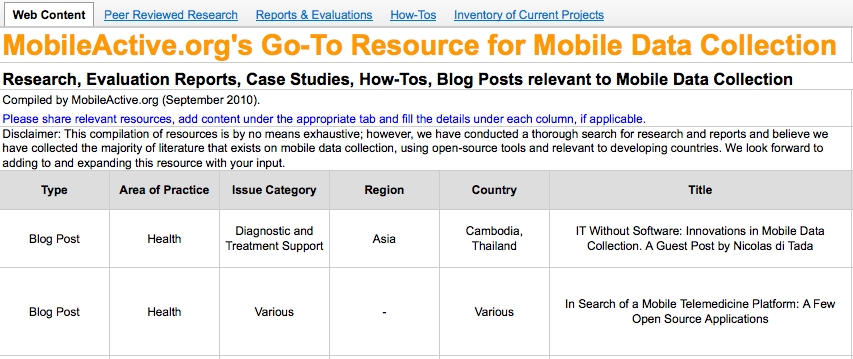
Want to use mobiles for data collection? Don't know where to start your research or where to read evaluations of existing and past mobile data collection efforts? You're in luck! We've produced the resource guide you've been waiting for.
Recently, MobileActive.org collaborated with UN Global Pulse to crowdsource an inventory of mobile data collection projects around the world. While this growing inventory shows there is enormous interest to leverage mobile technology for data collection, technical reports and evaluations of deployments and pilots are scattered.
So, we took the lead and compiled the existing literature (as best as we could) in an easy-to-use spreadsheet here.
"MobileActive.org's Go-To Resource for Mobile Data Collection" is a roundup of resources, organized in five tabs:
Posted by melissaulbricht on Sep 10, 2010
The Takeaway is a national morning news program currently hosted by John Hockenberry and Celeste Headlee. It is a co-production of PRI (Public Radio International) and WNYC Radio in collaboration with the BBC World Service, The New York Times and WGBH Boston.
Posted by AnneryanHeatwole on Sep 10, 2010
BBC Janala is part of a multi-platform effort to bring English language education to millions of Bangladeshi people. It is part of the BBC World Service Trust’s “English in Action” program, dedicated to teaching English to 25 million people in Bangladesh. Using mobile phones, BBC Janala offers audio English lessons and quizzes to callers – and in a short amount of time has seen rapid pickup across the country.
Posted by AnneryanHeatwole on Sep 10, 2010
Today's Mobile Minute brings you coverage on using SMS to access social networks in Nigeria, Organizing for America's new iPhone app that aids political canvassers, HTC's development of a dual GSM and CDMA phone, a pilot project that uses SMS to send information to pregnant women in Peru, and a Pew Research Center report on U.S. adults' mobile phone usage habits.
Posted by AnneryanHeatwole on Sep 07, 2010
Today's Mobile Minute's coverage will feature release of the data-aggregating program SwiftRiver, feature phones' allure in developing countries, Nokia's entrance into the dual SIM card market, a new book that investigates how ICTs will have an effect on politics and culture in the Muslim world, and how RIM's response delayed India's proposed ban on BlackBerry services.
Posted by MohiniBhavsar on Sep 02, 2010
Author:
Susanto, T, D and Goodwin, R.
Abstract:
This paper identifies the factors that determine citizens’ acceptance of SMS-based e-government services. It reports on a web-based survey, paper-based questionnaires, and phone-call interviews that collected 159 responses from 25 countries. The results indicate that there are fifteen perceptions toward using SMS-based e-government services that may influence citizens to use or to reject the services:
- perceived ease of use
- perceived efficiency in time and distance
- perceived value for money; perceived usefulness
- perceived responsiveness; perceived convenience
- perceived relevance, quality and reliability of the information
- trust in the SMS technology
- perceived risk to user privacy
- perceived reliability of the mobile network and the SMS-based system
- trust in government and perceived quality of public services
- perceived risk to money
- perceived availability of device and infrastructure
- perceived compatibility; and
- perceived self-efficacy in using SMS.
Whether or not a citizen adopts an SMS-based e-government service is influenced by these perceptions. To increase the acceptance of SMS-based e-government services, the systems should address all of these belief factors. An intensive advertising campaign for the services in all mass media channels is critically important to make citizens aware of and to provide detailed knowledge about the services. The advertising campaign should involve people who influence individuals’ decision making. These people include friends, family, teachers, experts, public figures, and government officials. This study found that Notification services are the most frequently used followed by Pull SMS, Listen, and Transaction SMS services. Notification services could be an appropriate starting point for governments who want to establish SMS-based e-government services.
Posted by MohiniBhavsar on Sep 02, 2010
Author:
Ignacio Mas and Dan Radcliffe
Abstract:
M‐PESA is a small‐value electronic payment and store of value system that is accessible from ordinary mobile phones. It has seen exceptional growth since its introduction by mobile phone operator Safaricom in Kenya in March 2007: it has already been adopted by 9 million customers (corresponding to 40% of Kenya’s adult population) and processes more transactions domestically than Western Union does globally. M‐PESA’s market success can be interpreted as the interplay of three sets of factors: (i) pre‐existing country conditions that made Kenya a conducive environment for a successful mobile money deployment; (ii) a clever service design that facilitated rapid adoption and early capturing of network effects; and (iii) a business execution strategy that helped M‐PESA rapidly reach a critical mass of customers, thereby avoiding the adverse chicken‐and‐egg (two‐sided market) problems that afflict new payment systems.
Posted by melissaulbricht on Sep 07, 2010
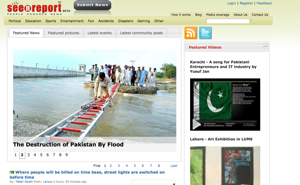
Check out our newest case study on SeenReport, a platform for citizen journalism in Pakistan.
Over 10,000 citizen reports relating to widespread flooding in Pakistan have been submitted across the spectrum of organizations using the SeenReport platform. The service allows anyone to create a profile and submit text, photos, and videos from a mobile phone for immediate publication on the Web.
The case study is part of the Mobile Media Toolkit that will include many other case studies, how-to guides, resources, and tools on how use mobile phones for reporting, content delivery, and citizen participation, to be puplished this Fall.
Posted by MohiniBhavsar on Oct 11, 2010
Author:
Jeffrey A. Hoffman, Janice R. Cunningham, Andrew J.Suleh, Aaron Sundsmo, Debra Dekker, Fred Vago, Kelly Munly, Emmy Kageha Igonya, Jonathan Hunt-Glassman
Abstract:
Growth in mobile phone penetration has created new opportunities to reach and improve care to underserved, at-risk populations including those with tuberculosis (TB) or HIV/AIDS.
This paper summarizes a proof-of-concept pilot designed to provide remote Mobile Direct Observation of Treatment (MDOT) for TB patients. The MDOT model combines Clinic with Community DOT through the use of mobile phone video capture and transmission, alleviating the travel burden for patients and health professionals.
Three healthcare professionals along with 13 patients and their treatment supporters were recruited from the Mbagathi District Hospital in Nairobi, Kenya. Treatment supporters were asked to take daily videos of the patient swallowing their medications. Patients submitted the videos for review by the health professionals and were asked to view motivational and educational TB text (SMS) and video health messages. Surveys were conducted at intake, 15 days, and 30 days. Data were collected in 2008 and analyzed in 2009
All three health professionals and 11 patients completed the trial. All agreed that MDOT was a viable option, and eight patients preferred MDOT to clinic DOT or DOT through visiting Community Health Workers.
MDOT is technically feasible. Both patients and health professionals appear empowered by the ability to communicate with each other and appear receptive to remote MDOT and health messaging over mobile. Further research should be conducted to evaluate whether MDOT (1) improves medication adherence, (2) is cost effective, and (3) can be used to improve treatment compliance for other diseases such as AIDS.