One of the largest parallel vote tabulation efforts is under way right now in Nigeria to observe and monitor gubernatorial elections. Project 2011 Swift Count is observing the national assembly, state assembly, and gubernatorial elections with 8000 trained election observers. The observers are also working across six high-priority states to complete parallel vote tabulations to verify the official results in six corresponding gubernatorial elections.
At around 9pm in Nigeria on election day, MobileActive.org spoke with Chris Doten, senior program officer on the ICT team for the National Democratic Institute (NDI). When we spoke with Doten, two-thirds of trained election observers had sent in via text message final vote counts, meaning the final tallying was complete at that particular polling place. A much higher percentage of observers have sent in summaries of total ballots cast.
NOTE: This article was updated with an addendum and additional data.
Inspired by Michael Benedict's original blog post on monitoring SMS delivery reliability in Tanzania and recent reports of SMS keyword blocking in Uganda, MobileActive.org set out to replicate Michael's work - and add to it. SMS is such a crucial part of many mobile projects and just day-to-day life across the developing world, yet there’s a lack of public knowledge of mobile network operator interdependency, latency, and reliability (how mobile network operators work together to transmit SMS, the lag time between sending and receiving a message, and the guarantee that a message will reach its recipient).
Michael's post got us thinking: Can this type of experiment be replicated without extra hardware required (GPRS modems, etc.)? After a few quick brainstorming sessions at the OpenMobile Lab in New York, we created an alpha version of a mobile application that recreates a number of latency tests. It’s far from perfect - and there is still plenty of work to be done - but we’re confident that this project will lead us to extremely valuable data about the transparency and reliability of SMS on mobile networks.
SMSTester - The App
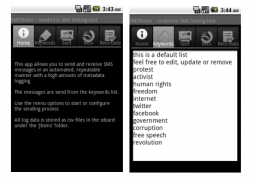
SMSTester is a simple Android app that allows a user create a set of keywords to be sent as SMS messages. This allows the user to explore differences in latency for any type of message - from basic, everyday text like ‘milk’ or ‘newspaper’ to politically inflammatory text such as ‘revolution.’ We then set up a logging mechanism to timestamp and record each SMS as it is sent (from the sender side) or received (on the receipt side). By comparing the sent and received timestamps, we’re very easily able to calculate message latency from one SIM to another.
Initial Deployment
We deployed SMSTester in a test in Egypt a few weeks ago. As this was the initial trial for a fully untested application, we were careful. While we did run our tests across a number of local mobile operator networks, we kept the test volume small enough to keep us under the radar (for now!). Our test methodology included:
Testing across all three major mobile operator networks in Egypt: Etisalat, Mobinil, and Vodafone
Consistent keyword test bed containing both ‘safe’ and ‘political’ terms, where ‘safe’ refers to everyday vocabulary and ‘political’ refers to politically sensitive words
Language coverage across both English and Arabic
Roughly 270 messages successfully sent, received and analyzed
What We Looked For And Why
The main focus of our analysis was SMS delivery latency, delay, or more generally, delivery failures. There are plenty of anecdotal stories of seemingly random delays lasting multiple hours or even days in many countries where we work. While network congestion and growing infrastructure are often to blame for SMS unreliability, there are also legitimate concern that delays may be an indication of deliberate message filtering and monitoring. What has emerged is an environment in which activists and human rights defenders are unable to clearly understand what networks - and what behavior - is safe or hazardous for themselves or their contacts. The end goal of this research, put simply, is to change this paradigm. Rumors of keyword filtering are not helpful; what is helpful is any evidence of surveillance.
This small experiment is just a start, of course. Our hypothesis is that keyword filtering and other malicious behavior on the part of mobile network operators may manifest in the form of increased message latency or overt message blockage. If we could detect any sign of a correlation between message content and delivery with just some initial testing in-country, this would be a great first step towards our overall goal. However it’s very important to note that while message latency or failure may be indicative of bad behavior on the part of the carries, it could be due to any number of contributing factors and is by no means an implication of foul play. For now we’re merely hypothesizing.
Results
Despite the minor bugs discovered, we gathered very valuable information about message latency in Egypt during this trial. The most valuable data was on the Etisalat network (also known as the Emirates Telecommunications Corporation), based in the UAE. The majority of the data we recovered from this trial was between an Etisalat SIM and other Egyptian networks. (Note: This was the result of inadvertent data loss for other test scenarios and we did not specifically target Etisalat).
Main Conclusions
Big Caveat (READ THIS!):Given the small sample size of this test, it should be noted that none of these conclusions are definitive. In fact, the very nature of such a small sample size warrants much further investigation.
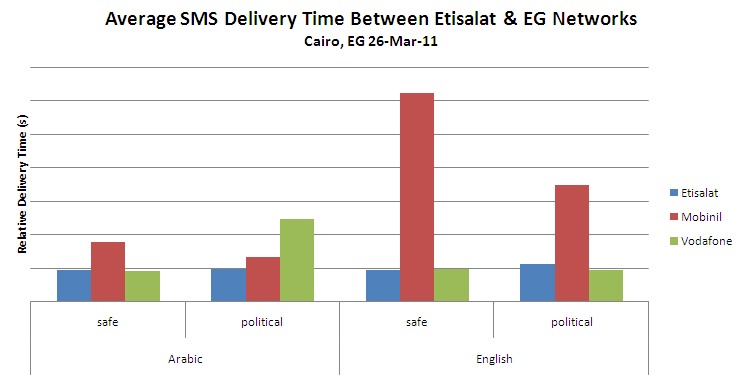
(1) Delivery between Etisalat & Mobinil networks warrants further investigation. As shown below, the delivery time for English language text messages from Etisalat to Mobinil is significantly greater than delivery time to any other network, for both English and Arabic texts. This may be due to any number of network delays, and it may also be indicative of English language filtering by one or both of the mobile network operators.
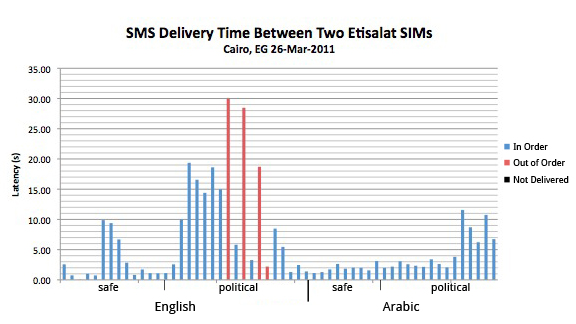
(2) Delivery time of politically sensitive English messages on Etisalat warrants further investigation. The chart below shows that politically sensitive English messages sent across the Etisalat network were delivered with significantly more latency than others, with the possible exception of politically sensitive Arabic messages. In addition, each of the three messages that were delivered out of order fell into this category. Similar to the above conclusion, this may be indicative of specific filtering on behalf of Etisalat.
Philly's Chinatown has struggled in recent years to maintain its geographic integrity with development encroaching its boundaries. There are internal challenges as well with frequent brak-ins and trash littering the streets. There is an imperative to coordinate residents, businesses and organizations to unite to address problems and prevent further encroachment. Yet, coordination and cooperation have been difficult to attain. For these reasons we wanted to design a communication system accessible via mobile phone specifically for Philadelphia’s Chinatown, to help its citizens and organizations address themselves, each other, and the greater Philadelphia community.
The range of dialects and cultural backgrounds in Chinatown make face-to-face communication rare for many residents. We wanted to create a social media system for our project that could potentially help forge social ties and build the essential element of trust in a new way. The system we envisioned would have features that address what we have identified as needs in the neighborhood:
Our goal for the project is to increase communication in Philadelphia's Chinatown neighborhood through a social media platform that allows for translation and an easy way for residents to report concerns and publicize events.
We also aim to raise the profile and recognition of organizations working in the community by helping them form agile responses to resident concerns. Altogether we want the community to feel it has the power to accomplish goals everyone can agree on.
Brief description of the project:
Fu Chi is a project that utilizes the open source software Ushahidi to raise civic engagement and communication among residents in Philadelphia's Chinatown currently separated by dialects, generations, socioeconomic status, and culture. Fu Chi allows residents to report issues, events, and opinions and respond to other user’s comments. Through a collaborative design process with residents, social organizations and city government, Fu Chi aims change resident’s perception of their potential impact on the environment; at the same time it will streamline and draw attention to the work done by social organizations serving the neighborhood.
Target audience:
Residents and organizations in Philly's Chinatown, and anyone outside the community who is interested.
We engaged in a thorough participatory design process that engaged residents and community groups along the way to articulate and express their concerns and desires for the neighborhood before deciding on a specific tool.
What did not work? What were the challenges?:
A major roadblock for us was communicating the potential of our interventions to the stakeholders and leaders of the community. We found that as we became well-versed in the potential of technology and design to revolutionize communication, it was hard for many of the people we were working with to understand what we were talking about. A major lesson for us and others taking on similar projects is to devote time and effort to explain your project in terms the stakeholders understand. Though we researched numerous examples of other communities using similar systems, and showed them the results of our clean up day test, it was difficult for some people to see how it could save time, they only saw the immense effort needed in our system to do the tasks of translation and publicity.
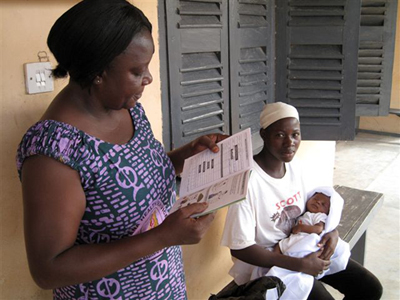
The Grameen Foundation
recently released an in-depth report on the
state of MoTeCH, a multi-part project that uses mobile technology to
send pre- and post-natal health information to Ghanaians and allows
community health workers to collect and share health data. Launched in
July 2010 in the Upper East Region of Ghana, the system rolled out
the next phase of the pilot in April 2011 in the Awutu
Senya distract in the Central Region of Ghana. The report, "Mobile
Technology for Community Health in Ghana: What It Is and What
Grameen Foundation Has Learned So Far," takes an honest look at the
progress and challenges the organization has faced while implementing a
long-term, large-scale mHealth project.
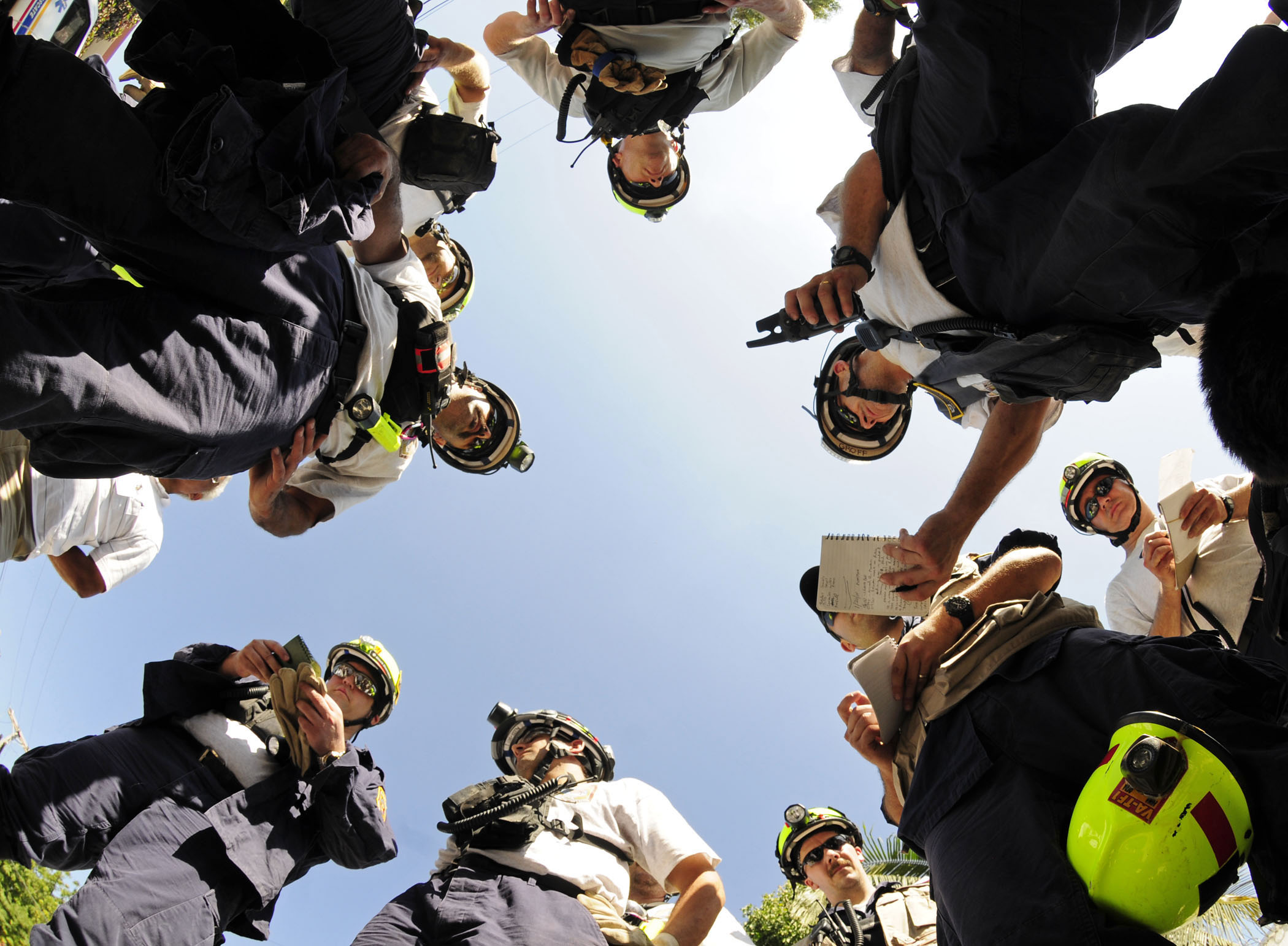
Editor’s Note: In this article, guest contributor Paul Currion looks at the potential for crowdsourcing data during large-scale humanitarian emergencies, as part of our "Deconstructing Mobile" series. Paul is an aid worker who has been working on the use of ICTs in large-scale emergencies for the last 10 years. He asks whether crowdsourcing adds significant value to responding to humanitarian emergencies, arguing that merely increasing the quantity of information in the wake of a large-scale emergency may be counterproductive. Instead, the humanitarian community needs clearly defined information that can help in making critical decisions in mounting their programmes in order to save lives and restore livelihoods. By taking a close look at the data collected via Ushahidi in the wake of the Haiti earthquake, he concludes that crowdsourced data from affected communities may not be useful for supporting the response to a large-scale disaster.
1. The Rise of Crowdsourcing in Emergencies
Ushahidi, the software platform for mapping incidents submitted by the crowd via SMS, email, Twitter or the web, has generated so many column inches of news coverage that the average person could be mistaken for thinking that it now plays a central role in coordinating crisis responses around the globe. At least this is what some articles say, such as Technology Review's profile of David Kobia, Director of Technology Development for Ushahidi. For most people, both inside and outside the sector, who lack the expertise to dig any deeper, column inches translate into credibility. If everybody's talking about Ushahidi, it must be doing a great job – right?
Maybe.
Ushahidi is the result of three important trends:
Increased availability and utility of spatial data;
Rapid growth of communication infrastructure, particularly mobile telephony; and
Convergence of networks based on that infrastructure on Internet access.
Given those trends, projects like Ushahidi may be inevitable rather than unexpected, but inevitability doesn't give us any indication of how effective these projects are. Big claims are made about the way in which crowdsourcing is changing the way in which business is done in other sectors, and now attention has turned to the humanitarian sector. John Della Volpe's short article in the Huffington Post is an example of such claims:
"If a handful of social entrepreneurs from Kenya could create an open-source "social mapping" platform that successfully tracks and sheds light on violence in Kenya, earthquake response in Chile and Haiti, and the oil spill in the Gulf -- what else can we use it for?"
The key word in that sentence is “successfully”. There isn’t any evidence that Ushahidi “successfully” carried out these functions in these situations; only that an instance of the Ushahidi platform was set up. This is an extremely low bar to clear to achieve “success”, like claiming that a new business was successful because it had set up a website. There has lately been an unfounded belief that the transformative effects of the latest technology are positively inevitable and inevitably positive, simply by virtue of this technology’s existence.
2. What does Successful Crowdsourcing Look Like?
To be fair, it's hard to know what would constitute “success” for crowdsourcing in emergencies. In the case of Ushahidi, we could look at how many reports are posted on any given instance – but that record is disappointing, and the number of submissions for each Ushahidi instance is exceedingly small in comparison to the size of the affected population – including Haiti, where Ushahidi received the most public praise for its contribution.
In any case, the number of reports posted is not in itself a useful measure of impact, since those reports might consist of recycled UN situation reports and links to the Washington Post's “Your Earthquake Photos” feature. What we need to know is whether the service had a significant positive impact in helping communities affected by disaster. This is difficult to measure, even for experienced aid agencies whose work provides direct help. Perhaps the best we can do is ask a simple question: if the system worked exactly as promised, what added value would it deliver?
Smart Diaphragm is an early warning system for high-risk pregnancies. Pregnant women insert a sensor-enabled diaphragm, which monitors changing collagen levels in the woman's cervix, and the results are wirelessly transmitted via bluetooth-enabled phones to a cloud data storage system.
 : In this article, guest contributor Paul Currion looks at the potential for crowdsourcing data during large-scale humanitarian emergencies, as part of our


