SharedSolar is a collaborative research effort between the below institutions and individuals. The technology is currently being piloted throughout the Millennium Villages in Africa.
As part of the connected MobileActive.org community of practice, we feature relevant mobile research. If you've been following our Mobile Research At Your Desk Series, you already have a sense of wide range of articles that we've gathered in the mDirectory. (For a full list, see below!)
This slidecast outlines findings from a large-scale study carried out by the Indian Council for Research on International Economic Relations. Sanjay Gandhi, Gaurav Tripathi, and Dr. Surabhi Mittal interviewed 200 small scale farmers to highlight the best uses of mobiles to support agricultural productivity.
The authors organized 17 focus groups over four months across India, and conducted 46 individual interviews with subsistence farmers. In total, they spoke to 200 people, living in villages where both mobile services and agricultural information sources are available. Farmers grew a wide of crops and average household incomes varied. The researchers partnered with organizations that provided agricultural information services linked to mobile phones.
We have gathered over 230 journal articles, evaluations and reports on mobiles for development in the mDirectory - a one-stop literature bank on mobiles in social change useful for practitioners and NGOs.
In our "Mobile Research At Your Desk" series, we've featured the work of researchers in the ICT4D field, covering a range of applications. Here's a list of our slidecasts to date:
The ubiquity of the mobile phone in Africa, the accessibility, the usability and crucially, the
bottom-up nature of its growth, has challenged the traditional ICT for development analysis.
People with very little income are prioritising mobile phones and airtime, clearly convinced of
the value to their lives and livelihoods. People who are traditionally the targets of development
aid are mobilising themselves not only to access mobile phones but innovate new functions
and applications which meet their particular needs.1
But beyond the excitement about the potential for mobile phones some voices of caution are
emerging, highlighting gender differences in access and control, for example, or the tendency
for social and economic hierarchies to be reinforced. There is also recognition that the value of
projects using mobile phones, as with any other ICT, can only be as strong as the quality and
appropriateness of the content shared.
There are several examples of pilots and services using mobiles for development or social
change in Africa, though the group of champions is still fairly small. However, a review of
the literature shows some unique and powerful factors which point to mobiles as a key tool
in enhancing the communication capacity and information access of poor and marginalised
communities across Africa. Most of the projects and pilots that do exist grew out of creative
and innovative processes of matching opportunities to needs, so it seems that an understanding
of what mobiles can do, and a review of the types of support and advice out there for people
wanting to use them, could really enhance planning of all types of development activities and
relationships.
Given this situation, Plan Finland commissioned this research into the potential value of mobile
technologies to the type of child-centred community development work to which they are
committed. While the nature, scope and scale of any work involving mobile technologies
will depend entirely on the context, stakeholders and development objectives, this guide
provides:
• an overview of relevant and innovative examples of how mobile telephones have
been successfully integrated into development projects and processes; and
• a three stage process to help Plan staff and other development practitioners identify
the key social, economic and technical factors and issues they need to consider when
planning to use mobile technologies.
The information provided and analysed here is derived from a literature review and interviews
with people in the field. A list references is provided at the end of this guide. It is hoped that
this blend of examples, learnings and reflections will support Plan’s staff and partners to make
well-informed decisions about integrating mobile technologies into their work.
We have gathered over 200 journal articles, evaluations and reports on mobiles for development in the mDirectory - a one-stop literature bank on mobiles in social change useful for practitioners and NGOs.
In our "Mobile Research At Your Desk" series, we've featured the work of researchers in the ICT4D field, covering a range of applications. To recap, here's a list of our slidecasts:
The fifth slidecast focuses on the work of Laurie Butgereit. She developed Dr. Math, an educational tool for South African youth, based on the popular mobile instant messaging service called MXit. The report was presented at the IST-Africa Conference in 2009.
MobileActive.org connects people, organizations, and resources using mobile technology for social change.We are committed to increasing the effectiveness of NGOs around the world who recognize that the more than 5 billion mobile phones provide unprecedented opportunities for organizing, communications, and service and information delivery.We work together to create the resources NGOs need to effectively use mobile phones in their work: locally relevant content and services, support and learning opportunities, and networks that help MobileActives connect to each other. With these things on hand, tens of thousands of NGOs will be in a better position to enrich and serve their communities.The MobileActive.org community includes grassroots activists, NGO staff, intermediary organizations, content and service providers, and organizations who fund mobile technology projects.MobileActive is committed to expanding the knowledge and experiences about the use of mobile phones and to accelerating the use of effective strategies and tactics while reducing the learning costs for organizations.
Transparency International Georgia is working to make information about Parliament available to more people via SMS messaging. The civil society organization was recently awarded a grant from the Open Society Institute and is several months into a project that sends Twitter-like messages on Parliamentary scheduling information. Derek Dohler, Digital Analyst for TI Georgia, said that information on upcoming meeting agendas and drafts is not readily available to many in Georgia.
The text messages speed up the process of getting information out, Dohler said. Right now, information about what is happening in Parliament is available weekly or semi-weekly, but there is no way for people to get an up-to-the-minute idea of what is really going on, Dohler said. MobileActive.org spoke with Dohler to hear how the project is going.
The goal of the project is to provide the public with information about Parliament.
Brief description of the project:
Transparency International Georgia is working to make information about Parliament available to more people via SMS messaging. The civil society organization was recently awarded a grant from the Open Society Institute and is several months into a project that sends Twitter-like messages on Parliamentary scheduling information to people who sign up for the service.
Target audience:
The target audience is people in Georgia who want to receive more information on Parliament. Messages are sent to anyone who signs up for the service. The only cost to the user is the cost to send an initial text message to sign up, by texting “join” to +99599009966. In Georgia, receiving text messages is free. People can also sign up online at no cost. A Georgia number is required (+995), and messages are available in English or Georgian. A user can also select specific committee updates, such as agrarian, budget, or legal issues.
TI Georgia chose to build a system around text messaging. SMS is already a popular mode of communication across the country, and an ideal way to communicate quickly. With SMS messages, more people are able to receive information, and at no cost to the user.
What did not work? What were the challenges?:
One challenge Dohler and his team faced was establishing a physical office in Parliament. There was a significant delay in the project to gain this access. The team experienced challenges with RapidSMS in that documentation was lacking. For example, documentation was often outdated, and there was no indication of when the team was using outdated documentation, or not.
If you are participating in a peaceful assembly as a journalist, rights defender, or activist, your mobile phone is an invaluable asset to communicate with allies, to document the event, and bear witness to what is happening around you. At the same time, you should take certain precautions in your mobile use and communications.
The following guide can help you to utilize your mobile phone during peaceful assemblies effectively and, at the same time, better protect yourself.
If you are participating in a peaceful assembly as a journalist, rights defender, or activist, your mobile phone is an invaluable asset. It allows you to communicate with allies, to document the event, and bear witness to what is happening around you. At the same time, you should take certain precautions in your mobile use and communications. The following Guide can help you to utilize your mobile phone during peaceful assemblies effectively and, at the same time, better protect yourself.
Assess Mobile Risks
In most public assemblies, you face risks from:
Loss and seizure of your mobile phone;
Disruptions to service from hardware or network failures;
Surveillance of your communications.
Each of these risks can be mitigated to some extent so long as you plan ahead, know your phone, and the basics of how mobile communications works. Remember though that every situation is different and that mobile phones are inherently insecure communication devices. We urge you to review this Primer on Mobile Risks for more guidance in assessing your mobile risks.
Transparency International Georgia (TI Georgia) is a local non-governmental organization committed to combating corruption in Georgia through the promotion of transparency and accountability
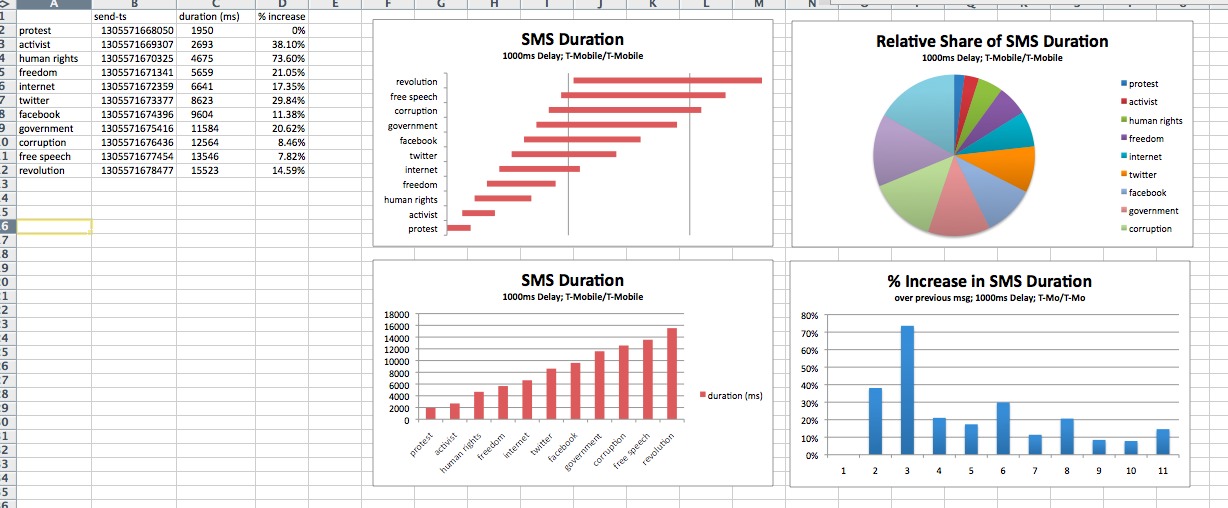
One of the main goals of the SaferMobile project is to release software tools that allow activists and rights defenders to use their mobile phones as network monitors and sensors. The goal is to help them, and the mobile developers, human rights organizations and people on the street they work with, to monitor network performance and proactively detect blocking, filtering and censorship. SMSTester is the first tool we are publicly releasing within this category, and it is free, freely licensed and open-source. Our first trial run with Short Message Service Tester (SMSTester) was completed in April 2011. The results are written up here.

 Assess Mobile Risks