The Freedom from Fistula Foundation (FFF) in Kenya and Comprehensive Community Based Rehabilitation in Tanzania (CCBRT) have taken great strides in reducing these barriers. Using a combination of mobile banking, public information, and free treatment, they have helped make fistula repair a reality for women who were previously excluded from care.
The purpose of this research is to empirically examine the ways in which Indonesian civil society organisations and groups engage in civic activism by means of the use of Mobile phones, Internet and social media; and how this civic engagement impacts upon the shaping of civil society in Indonesia.
With technology and its use continuously shifting and being shaped, the appropriation of the Internet and social media in Indonesian civil society is more about process than outcome. The technologies are continuously modified and adapted to bring them into alignment with the organisations’ routines. ‘Citizens in action’ are therefore never fixed in format, but rather ‘constituted and reconstituted’ through the everyday practices of the civil society groups and communities involving citizens and activists alike in ongoing actions – where technology serves as a convivial means.
The goal of the plan is to inform infoDev-supported mobile application labs in Africa, Asia, and Eastern Europe and Central Asia (ECA) – and other mobile application laboratory initiatives globally – to develop sustainable business models and transition from a donor-funded start-up phase to a selffinancing, sustainable phase over a three-year period.
The plan's six chapters cover the following topics:
Landscape Analysis describes mobile applications labs and similar organizations, including success factors and challenges across these labs.
Segmentation Analysis offers a typology of mLabs based on relevant defining characteristics and explores examples from parallel fields (e.g., software development, business incubation, technology transfer) to identify the characteristics of labs that function most effectively.
Offering & Promotional Strategies examines the services that best support sustainability for the mLab, and offers strategies for driving branding and awareness.
Business Model and Pricing Strategies defines potential revenue streams for the services that the labs offer, including potential price lists and menus of options that are tailored to regional markets via the companion Business Model Workbook Tool.
Operating Model provides recommendations on resource requirements (e.g., equipment, staffing, skills) and the phased rollout of services and functions over time.
Customer and Partner Strategies including the identification of intermediate clients (e.g., mobile applications developers, SMEs), end clients (e.g., app stores, network operators, equipment manufacturers, governments) as well as potential partners, investors and donors.
Non-profit organization mPowering is developing customized mobile apps to help reach the ultra poor -- people living on less than $2 a day -- and connect them with funding opportunities and programs in the developed world.
Reaching individuals and supplying resources in remote regions has huge challenges. The goal of mPowering is to leverage existing mobile infrastructure to open up channels of access. The organization has ongoing programs in Nepal and India which provide incentives to poor individuals for reporting to school or work, via mobile application. The organization is also working to create a mobile donor app to further connect the poor with funding opportunities.
Before a mobile app can be developed and deployed, the mPowering team conducts field research and partners with local institutions. We spoke with Kamael Ann Sugrim, Co-founder and CEO of mPowering, to find out how an app is developed.
The goal of mPowering is to help people living below the poverty line by leveraging mobile technology and developing unique mobile applications for development.
Brief description of the project:
Non-profit organization mPowering is developing customized mobile apps to help reach the ultra poor -- people living on less than $2 a day -- and connect them with funding opportunities and programs in the developed world.
Reaching individuals and supplying resources in remote regions can present challenges. The goal of mPowering is to leverage existing mobile infrastructure to open up channels of access. The organization has ongoing programs in Nepal and India which provide incentives to the poor for reporting to school or work, via mobile application. The organization is also working to create a mobile donor app to further connect the poor with funding opportunities.
Target audience:
Two ongoing programs are taking place in Bhaktapur, Nepal and Orissa, India. In Nepal, mPowering is working with women, and in India, with school children.
Status:
Ongoing
Anticipated launch date:
What worked well? :
Before an mPowering application is developed, such as the one being used in Orissa, the team conducts field research in program locations. Also, parterning has proved key. mPowering employs local individuals to help operate the programs in Nepal and India. The organization also holds training sessions for families and individuals who receive mPowering phones, and supplies phone chargers at check-in locations.
What did not work? What were the challenges?:
A recurring challenge for mPowering is mobile access and service. In some program locations, service can be limited and it can be difficult to figure out how to collect data via the app. There have been some design challenges, too, which stem from a push versus pull approach.
[Updated with audio recording: If you'd like to hear this Mobile Minute in audio form, check out this podcast recorded by Ashiyan Rahmani-Shirazi @ashiyan]
Today's Mobile Minute brings you coverage on Egypt's ruling against former president Mubarak for cutting Internet and mobile services, the rise of online phone calls, the operating system with the most data downloads, an effort to crowdsource citizen reports from the upcoming Turkish elections, and a look at mobile web content and access in East Africa.
Former Egyptian president Hosni Mubarak has been fined $34 million by an Egyptian court for cutting access to Internet and mobile phone networks during protests earlier this year. Other Egyptian officials (former interior minister Habib al-Adly and former prime minister Ahmed Nazif) were fined as well, for a total of $90 million in fines among the three former leaders.
A new report from the Pew Research Center reveals that online phone calls are becoming much more common. The center reports that 5% of Internet users go online to make a phone call each day, and 24% of adult American Internet users have used the Internet to make a phone call.
Curious about which operating system users download the most data? Wonder no more – Android owners use roughly 582 MB of data each month, compared to Apple users who came next with 492 MB of data. The information, compiled by Nielsen, also found that although Android users use more data, iPhone owners downloaded more apps.
Turkey's elections are coming up on June 12th, and students at the Istanbul Bilgi University have launched a crowd-sourcing website in order to report on the election. Called CrowdMap, the site maps reports from SMS, email, Twitter, and other Internet sources to provide instant updates about the election outside of the mainstream media.
Deficits in physical infrastructure, problems with availability of agricultural inputs and poor access to agriculture-related information are the major constraints on the growth of agricultural productivity in India. The more rapid growth of mobile telephony as compared to fixed line telephony and the recent introduction of mobile-enabled information services provide a means to overcome existing information asymmetry. It also helps, at least partially, to bridge the gap between the availability and delivery of agricultural inputs and agriculture infrastructure.
This paper investigates a series of questions that explore this topic:
What kind of information do farmers value the most to improve agricultural productivity?
Do mobile phones and mobile-enabled agricultural services have an impact on agriculture?
What are the factors that impede the realisation of the full productivity enhancing potential of mobile phones?
The answers to these questions have important implications for mobile operators, for information service providers, and for policymakers. The quality of information, its timeliness and trustworthiness are the three important features that have to be ensured to enable farmers to use it effectively to improve productivity.
The study found evidence that mobiles are being used in ways which contribute to productivity enhancement. However, to leverage the full potential of information dissemination enabled by mobile telephony will require significant improvements in supporting infrastructure and capacity building amongst farmers to enable them to use the information they access effectively.
As mobile penetration continues to increase among farming communities and information services continue to adapt and proliferate, the scope exists for a much greater rural productivity impact in the future.
It's a brand new month, and June is bursting with tons of mobile-themed events around the world! From hackathons for developers and coders to in-depth discussions about mobiles for social change and development, this month's events cover a wide range of topics and sectors. Check them out below:
1-2 June AppsWorld Africa 2011 (Cape Town, South Africa) How can mobile apps be used for development in Africa? This two-day conference uses workshops and exhibitions to explore the potential of apps in sectors ranging from health and agriculture to business and banking.
4-5 June Random Hacks of Kindness (global) This Random Hacks of Kindness hackathon will focus on both disaster risk and climate change. Experts in disaster risk and climate change submit challenges they've faced in their work, and developers and coders gather together to build solutions.
6-9 June Mobile Health Summit(Cape Town, South Africa) Co-hosted by the GSMA and the mHealth Alliance, this three-day event is the go-to place for leaders in the mobile and health fields to learn how mobile technology can improve on global health practices.
8 June Mobile Applications for Development Workshop (Washington, D.C., USA) Hosted by the Inter-American Development Bank, this workshop focuses on the role of mobile and Internet technologies in fostering social development.
8-9 June Open Mobile Summit (London, UK) For businesses looking to create a mobile presence, the Open Mobile Summit covers all the bases. From workshops on monetizing apps to targeting audiences through social media, panel leaders discuss how to mobilize your business.
8-9 June AITEC Banking and Mobile Money: West Africa (Accra, Ghana) The theme of this two-day event is how mobile banking can drive trade and investment in West Africa. The event looks at how traditional banks can use mobile banking, and the benefits of providing mobile banking options for people at the bottom of the pyramid.
14-15 June PIVOT25 (Nairobi, Kenya) PIVOT25 is an mLAB dedicated to supporting the growth of mobile entrepreneurs in Tanzania, Uganda, Rwanda, Burundi, Kenya, Somalia and Southern Sudan. Discussion topics at the event include the role of women in ICTs and the use of mobile applications in government, health, banking, and games.
For the largest civil society media platform in Tanzania, back talk is good.
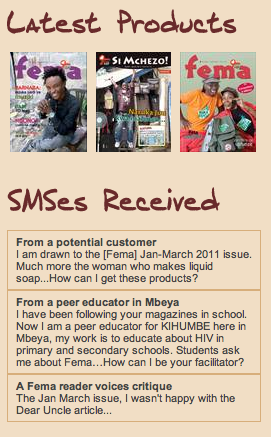
In fact, talking back is the objective of a new service at Femina HIP called Speak Up! The service aims to increase access of marginalized youth and rural communities and promote a participatory, user-driven media scene in Tanzania.
Femina HIP is the largest civil society media platform in the country, outside of commercial mainstream media. Products include print magazines, television shows, a radio program, and an interactive web site. Fema magazine, for example, has a print run of over 170,000 copies and is distributed to every rural region in the country.
Speak Up! aims to increase access of marginalized youth and rural communities and promote a participatory, user-driven media scene in Tanzania.
Brief description of the project:
Over the last few years, Tanzanian media outlet Femina HIP has encouraged its audience to connect and comment by sending letters, email, and SMS messages. Speak Up! is a service that offers a more automated, organized way to receive and respond to incoming SMS messages. The service is funded for one year.
Target audience:
The Femina HIP and Speak Up! target audience is marginalized youth and rural communities in Tanzania. Femina HIP with its media holdings reaches an estimated 10 million Tanzanians every year.
Status:
Ongoing
Anticipated launch date:
What worked well? :
Femina HIP is already a popular media outlet in Tanzania. With its media holdings reaches an estimated 10 million Tanzanians every year. The Speak Up! service helps create a more more systematic and organized flow of messages from the Femina HIP audience. The service was built by a local wireless application service provider and works in collaboration with local mobile providers. With Speak Up!, Femina HIP is better equipped for two-way communication with the audience.
What did not work? What were the challenges?:
It has been challenging to help the audience understand how to send SMS to an automated service. If someone misses a space or spells a key word incorrectly, for example, the SMS is marked “invalid” and ends up in the trash box. Similarly, if people send a message that is over the 160-character limit of a text message, the second half of the message is also marked invalid. Another issue may be cost. While there is a cost to send a text message, sending an SMS to a shortcode actually carries a slightly higher cost.


 For the largest civil society media platform in Tanzania, back talk is good.


