Posted by VivianOnano on Jun 09, 2011
Abstract:
This report draws on the experiences of projects using mobile phone-based information and communication technologies (ICT) applications in a number of situations, including mobile monitoring and evaluation, m-banking, community development, literacy, anti-corruption, agricultural extension and agricultural value chain information and access.
The report begins with a general overview of the role that mobile phone-based ICT can play in development and commercial projects, focusing on the situations in which mobile phonebased applications are particularly appropriate, on the potential impacts that they can achieve and on their comparative advantages vis-a-vis other forms of mobile ICT.
The report then considers in more detail the experience of the projects in using mobile phone-based ICT, shedding light on such issues as the appropriateness and relevance of the systems used, their replicability and scalability and their sustainability.
Posted by SaferMobile on Jun 09, 2011
Posted by SaferMobile on Jun 09, 2011
Posted by SaferMobile on Jun 09, 2011
Posted by SaferMobile on Jun 08, 2011
Posted by SaferMobile on Jun 17, 2011
Abstract:
This article contains information to help you understand and mitigate mobile security risks related to Twitter. As always, remember that risks are context-specific, and depend on the environment you work in as well as whether you are communicating sensitive information. For more information on risk assessment, please review the Guide to Mobile Security Risk Assessment.
Twitter is a way to get your messages to a wider audience. However, you should know that from any platform (computer or mobile phone), it is not a secure method of communicating sensitive information. Consider the following guidelines:
- Your Tweets should only contain information you want to widely and publicly share. This should be public information that can be freely distributed by you, your organization, and your supporters, without any risk to individuals or organizational operations.
- Even if you protect your tweets so that only followers can see them, followers can easily retweet your messages, or access them over an insecure connection.
Posted by admin on Jun 07, 2011
[This post was written by Robert Goodier and originally appeared on Engineering for Change. It is reposted here with permission.]
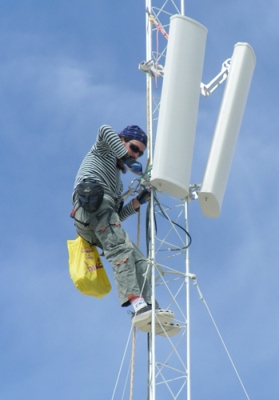
Three men who believe that cellphone service should be cheap and accessible to everyone have found a way to make it happen. The creators of OpenBTS, the open-source cellphone network, launched a startup and have delivered cheap cellphone networks to the world's biggest mobile tech corporations, governments and other clients on every continent. (Yes, even Atarctica—the Australian base is connected via OpenBTS.)
As we reported last year, OpenBTS is a network built on open-source software and hardware that works seamlessly with the average cellphone. With smart coding and decentralized call processing, the system has reduced the hardware needed and cuts the cost of installing and running a cellphone network to about one-tenth that of a traditional setup.
And, importantly for developing countries, the base tranceivers (the gear in the cell towers) are energy sippers that can run on PV cells. The bottom line: The whole network can reduce the cost of service to about $2-3 per month for subscribers.
We spoke with Glenn Edens, a co-founder of Range Networks, with a resume that includes such titles as former head of Sun Lab at Sun Microsystems, former president of AT&T Strategic Ventures, Chief of Strategic Technology at Hewlett-Packard and others. Edens summed up the last six months at Range Networks and told us what lies ahead for the startup.
Posted by VivianOnano on Jun 07, 2011
Author:
Ahmeda, S. Shubat and Ashraf M. Ali Edwila
Abstract:
In the mobile communication systems, security (encryption) offered by the network operator only applies on the wireless link. Data delivered through the mobile core network may not be protected. Existing end-to-end security mechanisms are provided at application level and typically based on public key cryptosystem.
The main concern in a public-key setting is the authenticity of the public key; this issue can be resolved by identity-based (IDbased) cryptography where the public key of a user can be derived from public information that uniquely identifies the user.
This paper presents an encryption mechanism based on the IDbased scheme using Elliptic curves to provide end-to-end security for SMS. This mechanism has been implemented over the standard SMS network architecture and the encryption overhead has been estimated and compared with RSA scheme. This study indicates that the ID-based mechanism has advantages over the RSA mechanism in key distribution and scalability of increasing security level for mobile service.
Posted by VivianOnano on Jun 07, 2011
Author:
Shapiro, N. Jacob and Nils B. Weidmann
Abstract:
Cell phones are assumed to enhance communication among insurgents, thus making it possible for them to coordinate more effectively. On the other hand, mobile communications can also hamper insurgent activity, by allowing the population to share information with counterinsurgents.
This paper makes a first attempt to provide a systematic test of the effect of cell phone communication on conflict. Using data on Iraq’s cell phone network as well as event data on violence, we assess this effect at two levels. First, we analyze how violence at the district level changes as a result of the introduction of new cell phone towers. Second, using a novel identification strategy, we examine how insurgent operation in the tower’s vicinity is affected by the introduction of coverage.
Taken together, our results show that mobile communication seems to increase the information flow from the population to the military, thus reducing insurgent effectiveness and ultimately, violence.