The Developmental Contribution from Mobile Phones Across the Agricultural Value Chain in Rural Africa data sheet 269 Views
Author:
Furuholt, Bjorn and Edmund Matotay
Publication Date:
Jan 2011
Publication Type:
Report/White paper
Abstract:
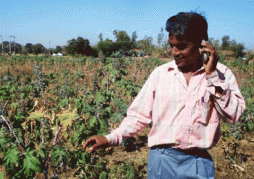
The most widespread information and communication technology (ICT) in developing countries today is the mobile phone. The majority of people in the least developed countries still live in rural areas and their livelihood depends on the primary industries. This study investigates the use of mobile phones among farmers in rural Tanzania in order to supply empirical data on the developmental role of this technology. The results show that the improved access to communication and information that mobile phones represent affects the entire cyclic farming life during the year and has resulted in considerable changes in the entire livelihood constructs, increased opportunities and reduced risks for rural farmer.
How can you share information across rural areas with limited or non-existent Internet connections? This is the question that Awaaz.De, an India-based organization that uses interactive-voice-response (IVR) systems to share information on mobile phones, is working to answer.
Co-created by Neil Patel and Tapan Parikh, both at the University of California at Berkeley, Awaaz.De is used by organizations to share information with voice as the primary channel. This could, for instance, take the form of a question and answer service, voice discussion forums, voice surveys, and automated calls.
Because of the open-ended structure of the Awaaz.De platform, the platform has been adapted by very different organizations. Labor Voices uses Awaaz.De to allow migrant workers to review jobs and employers in a voice database; the Development Support Centre uses the service to provide information to small-scale farmers as part of the Avaaj Otalo project (covered by MobileActive.org here), and Galli Galli Sim Sim (the Indian version of Sesame Street) uses the service to allow pre-school teachers to share teaching experiences and information about educational activities.
According to Patel in a post on the ICT 4 Community Health Worker discussion list, there are now eight organizations using Awaaz.De. These organizations have, together, produced more than 100,000 calls from about 10,000 unique callers.
Sauti ya wakulima, "The voice of the farmers", is a collaborative, multimedia knowledgebase created by farmers from the Chambezi region of the Bagamoyo District in Tanzania. By using smartphones, farmers gather audiovisual evidence of their practices, and publish images and voice recordings on the Internet.
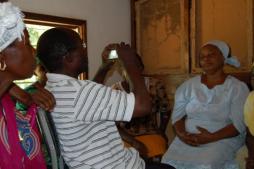
Since March 2011, the participants of Sauti ya wakulima, a group of five men and five women, gather every Monday at the agricultural station in Chambezi. They use a laptop computer and a 3G Internet connection to view the images and hear the voice recordings that they posted during the week. They also pass the two available smartphones on to other participants, turning the phones into shared tools for communication. The smartphones are equipped with GPS modules and an application that makes it easy to send pictures and sounds to the Internet. The farmers at Chambezi use them to document their daily practices, make reports about their observations regarding changes in climate and related issues, and also to interview other farmers, expanding thus their network of social relationships.
Video-mediated farmer-to-farmer learning for sustainable agriculture data sheet 755 Views
Author:
Van Mele, Paul
Publication Date:
Oct 2011
Publication Type:
Report/White paper
Abstract:
From June to September 2011, Agro-Insight conducted a scoping study for SDC, GFRAS and SAI Platform on the production, dissemination and use of farmer training videos in developing countries, with a focus on sustainable agriculture. Literature was consulted, the internet screened, experts and users consulted and a global on-line survey launched in English, French and Spanish.
There is a general consensus that farmers need good agricultural training videos, but they do not browse the web in search of them. For watching videos they rely mainly on outside agencies. Only about 20% of all respondents have never used video to train farmers and have never searched the web for agricultural videos. Many of those didn’t know where to look for videos, hadn’t found videos on the right subject or hadn’t found videos in their local language.
Mobile is one of the technologies discussed, but not the only. The study cites some mobile-based programs and notes current limitations to mobile video for farmers.
Upgrading development: Can technology alleviate poverty? data sheet 781 Views
Author:
Stuart, Emma Jackson
Publication Date:
Sep 2011
Publication Type:
Report/White paper
Abstract:
This report tackles ICT4D under three key headings: information, communication and participation. While not ignoring negatives, the report primarily explores, through the lens of Cambridge activities in ICT4D, the positive impacts and ongoing challenges of ICT4D: its ability to provide access to valuable information, to create meaningful two-way dialogues, to reach remote and excluded communities, and to empower the excluded to participate in their own development and societies.
There are still significant barriers preventing people in the Global South from accessing ICTs. But with the ongoing, rapid growth in mobile phone use and network connectivity across the world, the parameters are changing. We need to keep adapting to this environment in order to succeed. We must also ensure that the poorest and most disadvantaged are not left behind.
We have also seen challenges and progress that still need to be made in harnessing ICTs to achieve positive and lasting development outcomes. Technology can only ever be one ingredient in this process, but it can be a potent one. A key strength of ICT4D lies in the potential for participation, especially as technologies become more and more interactive.
Connected Agriculture: The role of mobile in driving efficiency and sustainability in the food and agriculture value chain data sheet 745 Views
Author:
Kirk, Matthew, Julie Steele, Christèle Delbé, Laura Crow, Steven Yurisich, Barry Nee, Gareth Weir, Kathryn Brownlie, Oliver Grange
Publication Date:
Oct 2011
Publication Type:
Report/White paper
Abstract:
This report focuses on the opportunity to improve agricultural productivity using mobile services, highlighting the opportunity to bring new investment to a key group: smallholder farmers. Mobile telephony could have significant potential to help the poorest farmers towards greater food and income security.
Only in recent years that mobile communications technology has been widely accepted as an enabler of sustainable growth. In developing markets, where the deployment of mobile telecommunications networks has surpassed traditional fixed-line technology, the mobile telecoms industry is well-placed as an enabler of higher performance in the value chain. There is a distinct need for market-led opportunities, and the opportunity for mobile operators to deliver these is significant.
The mobile services studied here enable companies to access and interact directly with different participants in the value chain, helping to build visibility of issues, capacity and quality. They will support company sustainability objectives, and in particular, progress towards the UN Millennium Development Goals by helping to reduce poverty, improve health and increase funding for education.
This report aims to stimulate the necessary engagement between mobile operators, governments, NGOs and businesses to realize these opportunities and explore others.
Leveraging Information and Communication Technology for the Base of the Pyramid data sheet 1020 Views
Author:
Carvalho, Alexandre de, Lucie Klarsfeld, Francois Lepicard
Publication Date:
Sep 2011
Publication Type:
Report/White paper
Abstract:
This document presents the conclusions of the study “Leveraging ICT for the BoP” sponsored by AFD-Proparco, Ericsson, ICCO, France Telecom-Orange, and TNO and conducted by Hystra and Ashoka from October 2010 to June 2011.
This study aimed to learn from “what works” in terms of full projects (as opposed to technologies) combining both an economically viable model and socio-economic impacts on their end-users, in the field of ICT for development (ICT4D). This work is thus based on the screening of existing projects led by various types of actors (social entrepreneurs, NGOs, private companies…), in 4 sectors of “development” where ICT has already shown it could play a key role: healthcare, education, agriculture, and financial services. 15 of the most ground breaking market-based business models, with a proven scale and results on the ground showing that ICT can be a lever improving the living standards of the BoP, are analysed in depth in the report to support the main conclusions.
Mobile phones may be one mechanism to increase effectiveness and efficiency for agricultural extension in low-income countries. Agricultural extension, broadly defined as the delivery of information to small-scale farmers, was developed to counteract information asymmetries suffered by farmers with limited access to information sources like landline phones, newspapers, radios and TV programming. This has meant that farmers have not been able to take advantage of innovations in agricultural production (from seed types to information about pest control or crop rotations) and have been largely unable to increase their yields and hence incomes.
While agricultural extension programs have tried to counteract this lack of information, they have also been long plagued by lack of scale, sustainability, relevance and responsiveness. Mobile phones, with their low-cost and capability for quick communication, may resolve many of these obstacles.
Half a century ago, extension programs were conceived to fill the glaring gap between agricultural innovation and crop yields. Despite great advances in agricultural innovations in the latter part of the twentieth century, farmers in Latin America and especially Sub-Saharan Africa have only seen slight increases in yields. Extension programs,which have largely taken the form of in-person visits and training, have consistently suffered from questions of cost-effectiveness.
Dial "A" for Agriculture: A Review of Information and Communication Technologies for Agricultural Extension in Developing Countries data sheet 1377 Views
Author:
Jenny C. Aker
Publication Date:
Mar 2011
Publication Type:
Report/White paper
Abstract:
Agriculture can serve as an important engine for economic growth in developing countries, yet yields in low-income countries have lagged far behind those in developed countries for decades. One potential mechanism for increasing yields is the use of improved agricultural technologies, such as fertilizers, seeds and cropping techniques. Public-sector programs have attempted to overcome information- related barriers to technological adoption by providing agricultural extension services.
While such programs have been widely criticized for their limited scale, sustainability and impact, the rapid spread of mobile phone coverage in developing countries provides a unique opportunity to facilitate technological adoption via information and communication technology (ICT)-based extension programs.
This article outlines the potential mechanisms through which ICT could facilitate agricultural adoption and the provision of extension services in developing countries. It then reviews existing programs using ICT for agriculture, categorized by the mechanism (voice, text, internet and mobile money transfers) and the type of services provided. Finally, we identify potential constraints to such programs in terms of design and implementation, and concludes with some recommendations for implementing field-based research on the impact of these programs on farmers’ knowledge, technological adoption and welfare.
Harvests of Development in Rural Africa: The Millenium Villages After Three Years data sheet 165 Views
Author:
The Earth Institute at Columbia University
Publication Date:
May 2011
Publication Type:
Report/White paper
Abstract:
At the UN Millennium Summit in September 2000, world leaders adopted the Millennium Declaration, committing nations to a new global partnership to reduce extreme poverty and address pressing challenges of hunger, gender inequality, illiteracy, and disease. The year 2015 has been affirmed as the deadline for reaching these Millennium Development Goal (MDG) targets.
The goal is to show how an integrated approach to community-level development can translate the international MDG agreements into ground-level breakthroughs throughout rural sub-Saharan Africa. Villages are located in deeply impoverished rural areas that were considered hunger hotspots—with at least 20% of children malnourished. Sites were selected to reflect a diversity of agro-ecological zones, representing a range of challenges to income, food production, disease ecology, infrastructure, and health system development.
The Millennium Villages Project is a ten-year initiative spanning two five-year phases. The first phase focuses on achieving quick wins, especially in staple crop production and disease control, and on establishing basic systems for integrated rural development that help communities escape the poverty trap and achieve the MDGs. The Project involves the coordinated community-led delivery of a locally tailored package of scientifically proven interventions for agriculture, education, health, and infrastructure. Over the first five-year phase, interventions are delivered at a modest cost, totaling approximately $120 per capita per year, of which MVP brings about half to complement funds from the host government, the local community, and other partners. The second five-year phase will focus more intensively on commercializing the gains in agriculture and continuing to improve local service delivery systems in a manner that best supports local scale-up.
Riding the Mobile Innovation Wave in Emerging Markets data sheet 1333 Views
Author:
Accenture
Publication Date:
Jan 2010
Publication Type:
Report/White paper
Abstract:
If communications and high-tech companies are to achieve their growth targets over the next few years, they must look to the emerging economies. These markets, with large populations, hold great promise. Although many consumers in these areas live in rural areas and rely on more limited means, their disposable income has risen in recent years. Many such consumers have become more confident about the future, and are now willing to buy aspirational products such as mobile phones and services, even on credit.
To achieve high performance in this environment, companies must understand the key mobile trends as they evolve in developing economies. They must develop a deeper understanding of the mobile value proposition to emergingmarket consumers as well as their distinctive service needs. New distribution networks must be created. Content, products and services need to be tailored to local populations. These challenges will require new models of collaboration to succeed in a more complex ecosystem.
Mobile coverage reaches over 90% of the world's population, but mobile services in traditionally rural, lower-income areas have lagged compared to opportunities in more urban areas. One company in India, Ekgaon, is tapping into the rural market by bringing financial, agricultural, and citizen-oriented mobile services to under-served regions. Vijay Pratap Singh Aditya, CEO of Ekgaon, explained to MobileActive.org how his company developed and evolved over the years.
With a focus on under-served markets, Ekgaon partners with financial institutions, agricultural organizations, NGOs, and corporations to bring mobile services to those who need them. Users of the agricultural system receive personalized and customized soil nutrient management information and crop advice along with weather updates, market information, and alerts; users of the financial services use mobiles to manage savings, remittances, insurance, investments and mortgages; and citizen services allow users to monitor and report on the delivery of government programs.
Riding the Mobile Innovation Wave in Emerging Markets data sheet 1247 Views
Author:
Accenture
Publication Date:
Jan 2010
Publication Type:
Report/White paper
Abstract:
If communications and high-tech companies are to achieve their growth targets over the next few years, they must look to the emerging economies. These markets, with large populations, hold great promise. Although many consumers in these areas live in rural areas and rely on more limited means, their disposable income has risen in recent years. Many such consumers have become more confident about the future, and are now willing to buy aspirational products such as mobile phones and services, even on credit.
To achieve high performance in this environment, companies must understand the key mobile trends as they evolve in developing economies. They must develop a deeper understanding of the mobile value proposition to emerging market consumers as well as their distinctive service needs. New distribution networks must be created. Content, products and services need to be tailored to local populations. These challenges will require new models of collaboration to succeed in a more complex ecosystem.
Study on Potentials of Mobile Phones in Investment and Development Projects data sheet 1329 Views
Author:
Poate, Derek
Publication Date:
Dec 2010
Publication Type:
Report/White paper
Abstract:
This report draws on the experiences of projects using mobile phone-based information and communication technologies (ICT) applications in a number of situations, including mobile monitoring and evaluation, m-banking, community development, literacy, anti-corruption, agricultural extension and agricultural value chain information and access.
The report begins with a general overview of the role that mobile phone-based ICT can play in development and commercial projects, focusing on the situations in which mobile phonebased applications are particularly appropriate, on the potential impacts that they can achieve and on their comparative advantages vis-a-vis other forms of mobile ICT.
The report then considers in more detail the experience of the projects in using mobile phone-based ICT, shedding light on such issues as the appropriateness and relevance of the systems used, their replicability and scalability and their sustainability.
As part of the connected MobileActive.org community of practice, we feature relevant mobile research. If you've been following our Mobile Research At Your Desk Series, you already have a sense of wide range of articles that we've gathered in the mDirectory. (For a full list, see below!)
This slidecast outlines findings from a large-scale study carried out by the Indian Council for Research on International Economic Relations. Sanjay Gandhi, Gaurav Tripathi, and Dr. Surabhi Mittal interviewed 200 small scale farmers to highlight the best uses of mobiles to support agricultural productivity.
The authors organized 17 focus groups over four months across India, and conducted 46 individual interviews with subsistence farmers. In total, they spoke to 200 people, living in villages where both mobile services and agricultural information sources are available. Farmers grew a wide of crops and average household incomes varied. The researchers partnered with organizations that provided agricultural information services linked to mobile phones.
We have gathered over 230 journal articles, evaluations and reports on mobiles for development in the mDirectory - a one-stop literature bank on mobiles in social change useful for practitioners and NGOs.
In our "Mobile Research At Your Desk" series, we've featured the work of researchers in the ICT4D field, covering a range of applications. Here's a list of our slidecasts to date:
Animation without Borders: Mobile Cartoons as a Teaching Tool data sheet 4523 Views
A team of scientists, animators, and educators are working together to create animated videos that can be sent and downloaded to mobile phones around the world. The animations can be done in any language, are targeted toward low-level literate learners, and convey methods to obtain safe water in Haiti or techniques to farm effectively in Africa, and concepts such as value in a marketplace exchange.
This University of Illinois project is called "Scientific Animation Without Borders", or SAWBO, for short. The project started about a year ago. As the team delivers the animations via mobile phone and other mechanisms, they also hope to deliver a more collaborative and bottom-up approach toward effective educational materials.
MobileActive.org spoke with university faculty and graduate students to hear more about animation, education, and mobile technology.
At Grameen Foundation our goal is simple – we want to see poor people, especially the poorest and those living in harder to reach areas, have access to microfinance and technology and as a result of access to these services, move themselves out of poverty. We envision a world where the poor have broken the generational chain of poverty and lead lives of respect, dignity and opportunity. Grameen Foundation, a nonprofit organization headquartered in Washington, DC with an office in Seattle, Washington, was founded in 1997 by friends of Grameen Bank to help microfinance practitioners and spread the Grameen philosophy worldwide. We share the ideas of 2006 Nobel Peace Laureate Muhammad Yunus. Grameen Foundation and Grameen Bank are independent organizations and have no financial or institutional links.
There is an enormous amount of literature on the use of mobiles in development work - from case studies and project evaluations, to broad policy recommendations and specific technology papers.
One place you can begin your search of relevant publications, reports and evaluations is in our mDirectory. For snapshots of the kind of information you can find there, here are more research slidecasts!
Way back in 2008, we spoke with Yael Schwartzman, who described her work in agricultural data collection. In this presentation, we feature a report published by Schwartzman, now a country manager at Frogtek in Mexico, and Tapan S. Parikh, assistant professor at UC Berekeley's School of Information.
Featherweight Multimedia for Information Dissemination data sheet 1351 Views
Author:
Chu, Gerry, Sambit Satpathy, Kentaro Toyama, Rikin Gandhi, Ravin Balakrishnan, and S. Raghu Menon
Publication Date:
Jan 2009
Publication Type:
Report/White paper
Abstract:
Featherweight multimedia devices combine audio with non-electronic visual displays (e.g., paper). Because of their low cost, customizability, durability, storage capacity, and energy efficiency, they are well-suited for education and information dissemination among illiterate and semi-literate people.
We present a taxonomy of featherweight multimedia devices and also derive design recommendations from our experiences deploying featherweight multimedia in the agriculture and health domains in India. We found that with some initial guidance, illiterate users can quickly learn to use and enjoy the device, especially if they are taught by peers.
Designing an Architecture for Delivering Mobile Information Services to the Rural Developing World data sheet 1527 Views
Author:
Parikh, Tapan S.
Publication Date:
Jan 2009
Publication Type:
Report/White paper
Abstract:
Populations in the rural developing world have just as many, if not more, information needs as people living in more affluent areas. But their constraints — intermittent power, intermittent connectivity, limited education, literacy and capital — make first-world approaches to accessing information systems inapplicable. Mobile phones are on the cusp of spurring an information revolution in such regions. Long battery life, wireless connectivity, solid-state memory, low price and immediate utility make this device better suited to rural conditions than a PC. However, current software on mobile phones makes them hard to use and to program.
In this dissertation, I present the design, implementation and evaluation of CAM — a mobile application framework designed to address the information needs of the rural developing world. Beginning with a two-month participatory design study, including users with varying levels of education, I propose some general guidelines for user interface and system design in this context. Motivated by these guidelines, I present CAM. CAM applications are accessed by capturing barcodes on paper forms using the mobile phone camera, or entering numeric strings with the keypad. Supporting one-step navigation, direct linkage to paper practices and offline multi-media interaction, CAM is uniquely adapted to rural device, user and infrastructure constraints. To demonstrate the usability of this framework, I implement and evaluate several distinct CAM-based applications (one of which has already been commercially deployed). I also provide preliminary motivation for fourteen other applications that could be implemented with the same, or similar, approach.
Mobile-based Livelihood Services in Africa: Pilots and Early Deployments data sheet 1575 Views
Author:
Donner, Jonathan
Publication Date:
Feb 2010
Publication Type:
Journal article
Abstract:
The paper describes a collection of initiatives delivering support via mobile phones to small enterprises, small farms, and the self-employed. Using a review of 26 examples of such services currently operational in Africa, the analysis identifies five functions of mobile livelihood services: Mediated Agricultural Extension, Market Information, Virtual Marketplaces, Financial Services, and Direct Livelihood Support. It discusses the current reliance of such systems on the SMS channel, and considers their role in supporting vs. transforming existing market structures.
Examining the Viability of Mixed Framework for Evaluating Mobile Services Impact in Rural India data sheet 1141 Views
Author:
Rao, Kasina V., Krithi Ramamritham, and R. M. Sonar
Publication Date:
Dec 2010
Publication Type:
Report/White paper
Abstract:
This paper examines the proposed framework for evaluating the impact of the intervention of mobile-based services on socio-economic development of Indian rural areas. Framework suitability has been studied using case study method with pilot test data. Existing literature shows multiple ways of studying mobile impact through different frameworks. The need for uniform framework is the felt need as various user-centric mobile services launched across rural markets. India becomes a field testing ground for most of the multinational firms who want to test their innovative business models. This framework provides a testing method for socioeconomic development impact on rural areas. This study adopted socio economic criteria (SEC) used by Indian marketers as basis for sample selection. The pilot study clearly shown that field is ready to test the proposed framework.
India: The Impact of Mobile Phones (ICRIER Report) data sheet 2244 Views
Author:
ICRIER
Publication Date:
Jan 2009
Publication Type:
Journal article
Abstract:
Research carried out by International Council for Research on International Economic Relations (ICRIER). The ICRIER researchers looked at three segments of the population – the agriculture sector, the Small and Medium Enterprise (SME) sector and urban slum dwellers. The research demonstrates that access to telecommunications is an important catalyst to realizing productivity and efficiency improvements and thereby making it possible for the benefits of economic growth. The research in this report on the uses and impacts of mobiles in agriculture show that improving productivity and rural incomes requires an array of enablers in the production cycle, which runs from planting to the final sale of produce; access to information is an important enabler.
The lack of adequate infrastructure is particularly acute in rural areas, home to 70% of India’s population and the 52% of the work force that is primarily engaged in agriculture and related activities. Agriculture in India accounts for 18% of national income, implying extremely low agricultural productivity. Until now, the focus of mobile operators’ attention has been on the more lucrative urban markets. The high cost of infrastructure rollout in less dense rural areas and affordability barriers for the rural population are likely reasons. But there are signs that this is changing. Infrastructure rollout in rural areas is now eligible for subsidy and all major providers have reported future plans for expansion in rural India.
Small farmers often struggle to access high-quality inputs such as advanced seed varieties, or services such as soil testing or credit, fertilizers, availability of loan options and efficient distribution networks and weather forecast. Therefore a very uneven access to information is seen currently. A national survey of farmers found that only 40% of farmer households accessed information about modern agricultural techniques and inputs while a lot of them still depend on other progressive farmers.
Today's Mobile Minute brings you the latest mobile news. Mobile Commons helps people find voting stations in the U.S. via SMS, Nokia pushes for rural users, NPR's mobile services win them an Online Journalism Award, and seven out of ten people store sensitive data on their mobile phones – without security measures.
Today is election day in the United States, so if you want to find out where your nearest polling station is, check out the Mobile Polling Place Locator by Mobile Commons. Text WHERE (for English instructions) or DONDE (for Spanish instructions) to 30644. You'll be prompted to enter your home address, and then be directed to your local polling center.
The New York Times reported on Nokia's Ovi Life Tools program, which uses basic text messages to transmit market and agricultural data to rural mobile owners. The program has already been successful in India, and now Nokia is gearing up to launch a similar program in Nigeria.
The BBC reported on a study from security firm Juniper Networks that found bad news for users worried about mobile security: "In its research covering 6,000 participants spread over 16 countries, Juniper found that 61% of all reported smartphone infections were spyware, capable of monitoring communication from the device. A further 17% were text message Trojans that charge fees to a device's account holder."
[Mobile Minute Disclaimer: The Mobile Minute is a quick round-up of interesting stories that have come across our RSS and Twitter feeds to keep you informed of the rapid pace of innovation. Read them and enjoy them, but know that we have not deeply investigated these news items. For more in-depth information about the ever-growing field of mobile tech for social change, check out our blog posts, white papers and research, how-tos, and case studies.